


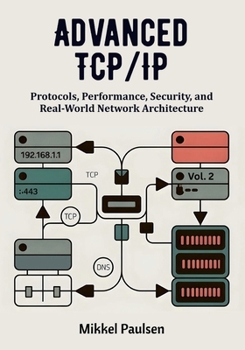
Advanced TCP/IP: Protocols, Performance, Security, and Real-World Network Architecture

TCP/IP does not stop at fundamentals. In real-world networks, performance bottlenecks, routing complexity, security boundaries, and cloud architectures expose behaviors that basic explanations never cover.
TCP/IP Fundamentals taught you how the system works.
Advanced TCP/IP shows you how it behaves under pressure.
This volume is a deep, practical exploration of TCP/IP as it operates in modern production environments. It focuses on performance tuning, routing decisions at scale, application-layer behavior, security trade-offs, and the realities of cloud, mobile, and virtualized networks.
Instead of treating protocols as isolated topics, this book examines how TCP/IP behaves across layers-how congestion control affects applications, how routing policy shapes traffic flow, how security mechanisms alter packet paths, and how modern infrastructure pushes the protocol stack in unexpected ways.
Written for professionals and serious learners, this book emphasizes reasoning, diagnosis, and architectural thinking. Concepts are explained clearly, supported by real-world examples, and framed around the kinds of problems engineers actually face.
This book is ideal for:
Network and systems engineers moving beyond fundamentalsDevOps and cloud professionals working with real production networksSecurity learners who want to understand protocol behavior beneath controlsDevelopers who need to reason about latency, throughput, and reliabilityAnyone preparing for advanced interviews or professional networking rolesIn this volume, you will learn:
How TCP connection states, flow control, and congestion algorithms affect performanceHow latency, throughput, jitter, and packet loss interact in real networksHow routing tables, metrics, and policies determine packet paths at scaleHow OSPF, EIGRP, and BGP shape modern enterprise and internet routingHow HTTP, HTTPS, TLS, and QUIC behave over the transport layerHow firewalls, VPNs, and Zero-Trust architectures alter traffic flowHow TCP/IP operates in cloud networks, containers, mobile systems, and satellite linksHow professionals diagnose complex, cross-layer network failuresThis book avoids vendor lock-in and configuration-heavy walkthroughs. Instead, it focuses on protocol behavior, architectural trade-offs, and diagnostic thinking-skills that transfer across platforms, tools, and environments.
Volume 2 builds on the foundation established in Volume 1, completing the picture with advanced performance analysis, routing, security, cloud networking, and professional troubleshooting.
If you want to move from understanding how TCP/IP works to confidently reasoning about how it behaves in real systems, this book is the next step.
Customer Reviews
ThriftBooks ® and the ThriftBooks ® logo are registered trademarks of Thrift Books Global, LLC
