


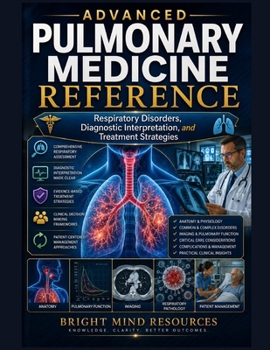
Advanced Pulmonary Medicine Reference: Respiratory Disorders, Diagnostic Interpretation, and Treatment Strategies
No Customer Reviews

UNDERSTAND THE RESPIRATORY SYSTEM. INTERPRET CLINICAL FINDINGS. APPROACH PULMONARY CONDITIONS WITH GREATER CONFIDENCE. Pulmonary medicine requires more than memorizing respiratory diseases. Effective respiratory care involves understanding anatomy and physiology, recognizing clinical patterns, interpreting diagnostic information, identifying important abnormalities, considering differential diagnoses, and connecting findings with appropriate treatment and patient-management decisions. **Advanced Pulmonary Medicine Reference: Respiratory Disorders, Diagnostic Interpretation, and Treatment Strategies** provides a structured clinical reference for understanding major concepts in pulmonary and respiratory medicine. Designed for healthcare students, clinicians, nurses, physicians, advanced practice professionals, respiratory care professionals, and healthcare trainees, this reference connects respiratory science with clinical assessment, diagnostic interpretation, and patient-centered management. ## BUILD A STRONG FOUNDATION IN PULMONARY MEDICINE A clear understanding of respiratory anatomy and physiology provides the foundation for interpreting pulmonary disease. The book explores: * Respiratory anatomy
* Lung function
* Ventilation
* Perfusion
* Gas exchange
* Oxygen transport
* Carbon dioxide elimination
* Pulmonary circulation
* Respiratory mechanics
* Airway function
* Alveolar function
* Respiratory regulation Understanding these principles helps readers connect physiological changes with clinical signs, symptoms, and diagnostic findings. ## APPROACH RESPIRATORY SYMPTOMS SYSTEMATICALLY Respiratory complaints can arise from numerous conditions. The book provides structured approaches to evaluating symptoms such as: * Cough
* Dyspnea
* Wheezing
* Chest discomfort
* Hemoptysis
* Sputum production
* Exercise intolerance
* Hypoxemia
* Abnormal breathing patterns
* Sleep-related breathing problems Rather than treating each symptom as an isolated problem, readers are encouraged to consider onset, duration, severity, associated findings, risk factors, and clinical context. # DEVELOP BETTER PULMONARY ASSESSMENT SKILLS Clinical respiratory assessment is an essential part of patient evaluation. The handbook explores: * Patient history
* Respiratory rate
* Breathing pattern
* Work of breathing
* Oxygen saturation
* Chest examination
* Inspection
* Palpation
* Percussion
* Auscultation
* Breath sounds
* Accessory muscle use
* Signs of respiratory distress The goal is to help readers organize findings into a meaningful clinical picture. # UNDERSTAND PULMONARY FUNCTION TESTING Pulmonary function testing provides important information about respiratory physiology. Readers explore the clinical interpretation of concepts including: * Spirometry
* Forced vital capacity
* Forced expiratory volume
* FEV1/FVC relationships
* Flow-volume loops
* Lung volumes
* Diffusing capacity
* Obstructive patterns
* Restrictive patterns
* Mixed patterns The emphasis is on understanding what testing can reveal and how results should be interpreted in clinical context.
* Lung function
* Ventilation
* Perfusion
* Gas exchange
* Oxygen transport
* Carbon dioxide elimination
* Pulmonary circulation
* Respiratory mechanics
* Airway function
* Alveolar function
* Respiratory regulation Understanding these principles helps readers connect physiological changes with clinical signs, symptoms, and diagnostic findings. ## APPROACH RESPIRATORY SYMPTOMS SYSTEMATICALLY Respiratory complaints can arise from numerous conditions. The book provides structured approaches to evaluating symptoms such as: * Cough
* Dyspnea
* Wheezing
* Chest discomfort
* Hemoptysis
* Sputum production
* Exercise intolerance
* Hypoxemia
* Abnormal breathing patterns
* Sleep-related breathing problems Rather than treating each symptom as an isolated problem, readers are encouraged to consider onset, duration, severity, associated findings, risk factors, and clinical context. # DEVELOP BETTER PULMONARY ASSESSMENT SKILLS Clinical respiratory assessment is an essential part of patient evaluation. The handbook explores: * Patient history
* Respiratory rate
* Breathing pattern
* Work of breathing
* Oxygen saturation
* Chest examination
* Inspection
* Palpation
* Percussion
* Auscultation
* Breath sounds
* Accessory muscle use
* Signs of respiratory distress The goal is to help readers organize findings into a meaningful clinical picture. # UNDERSTAND PULMONARY FUNCTION TESTING Pulmonary function testing provides important information about respiratory physiology. Readers explore the clinical interpretation of concepts including: * Spirometry
* Forced vital capacity
* Forced expiratory volume
* FEV1/FVC relationships
* Flow-volume loops
* Lung volumes
* Diffusing capacity
* Obstructive patterns
* Restrictive patterns
* Mixed patterns The emphasis is on understanding what testing can reveal and how results should be interpreted in clinical context.
Format:Paperback
Language:English
ISBN:B0HG8FLJ4N
ISBN13:9798194472390
Release Date:August 2026
Publisher:Independently Published
Length:278 Pages
Weight:1.43 lbs.
Dimensions:0.6" x 8.5" x 11.0"
Customer Reviews
0 rating
Copyright © 2026 Thriftbooks.com
Terms of Use | Privacy Policy | Do Not Sell/Share My Personal Information | Cookie Notice | Cookie Preferences | Accessibility Statement
ThriftBooks ® and the ThriftBooks ® logo are registered trademarks of Thrift Books Global, LLC
ThriftBooks ® and the ThriftBooks ® logo are registered trademarks of Thrift Books Global, LLC
