
Skip to content
Scan a barcode
Scan
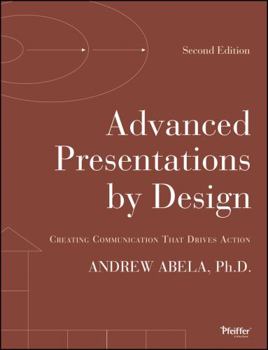
Paperback Advanced Presentations by Design: Creating Communication That Drives Action Book

ISBN: 0787996599

ISBN13: 9780787996598

Advanced Presentations by Design: Creating Communication That Drives Action

Select Format

Select Condition ThriftBooks Help Icon

Recommended

Format: Paperback

Condition: Very Good

$9.79
Save $43.16!
List Price $52.95
Almost Gone, Only 2 Left!

Book Overview

Advanced Presentations by Design overturns much of the conventional wisdom and practice for creating presentations. Based on over 200 research studies from the fields of communication, marketing, psychology, multimedia, and law, it provides fact-based answers to critical questions about presentation design, including how to adapt your presentation to different audience personality preferences, what role your data should play and how much of it you need, how to turn your data into a story, and how to design persuasive yet comprehensible visual layouts.

Customer Reviews

5 ratings

A must read for every presenter, manager, and leader

This book lays out a methodology to create presentations that make a real difference. And the method works - my company subscribes to Corporate Executive Board, a industry best practice research service that follows the methods in this book. CEB is one of the few companies that I make time to attend their presentations because they are worth my limited time. And not only is the research solid, the information is presented in a way that makes it understandable and makes an impact with executives and managers. The method is repeatable, simple, and can make a difference right away. I know. I've given a half dozen presentations using just some of the methods and have noticed my feedback scores increase. I've had people ask me for advice on presenting. That's results. This book isn't about presentations, flashy graphics, or even the Zen of presenting. It about communications. And it debunks a lot of presentation myths with solid research. Its worth its weight in gold (even at today's prices!) to people who need to get their point across to groups of any size.

A Practical How-To Guide To Planning and Developing Compelling Presentations

Professor Abela has compiled a step-by-step guide to how to plan and deliver compelling presentations. Let me dissect that praise: * Plan: Professor Abela walks you through the important questions you need to consider before you open up PowerPoint and begin pulling your slides together. This includes analyzing your audience, enumerating your objectives for the presentation and establishing a story structure through which you can marshall and convey your evidence. This is far and away the best framework of the many I have seen for pre-design work. The great thing about Professor Abela's framework for planning is that the framework is just as useful for meetings and speeches in which you will not be speaking to slides. Clearly the objectives, story and evidence are more important than the content of your PowerPoint slides. Wouldn't it be great to have a way forward if you are left with only 5 of your scheduled 30 minutes to present or the projector breaks down? Use Professor Abela's planning framework and you'll be ready. * Deliver: Not all venues are alike, and Professor Abela takes the best of Tufte and other visualization experts to lay out guidance for designing presentations for a ballroom and a boardroom setting. Abela provides workable guidelines for using charts and layout to visually augment your message. This book includes a number of standard charts that easily and clearly represent the basic concept you are trying to convey on each slide. As much as I enjoy Tufte, Abela's book gave me direct actionable guidance that I needed to augment my spoken message with visual evidence. Recently I applied the "Extreme Presentations" methods to a talk at a professional conference. The presentation itself (ballroom style) stood out as more visually informative than the standard corporate fare delivered by the other presenters. More important, though, is that I had clearly mapped out the change in mindset that I wanted to see in my audience. I had properly structured my talk to marshall the appropriate evidence in sequence and make the case successfully. As I created my problem-solution and anecdote outline I actually became excited for the opportunity to make my case to my audience. Following the presentation several attendees approached me to comment that I had changed their mind on the critical insight that was my goal. Using "Extreme Presentations" to create a presentation takes longer than the standard corporate presentation (at least my first presentations developed in this model have taken longer). The quality of the visuals and the reception by the audience really does deliver a worthy return on that time investment. It's clear to my audiences that I've taken the time to think about them, consider their interests and taken care to create a good-looking and relevant set of visuals. This quality makes it clear to my audiences that I care about them, and that goes a long way towards making the audience care about what I am c

A must-have for developing evidence-based presentations.

It's not every day I see a book offering chapters with names like "Marshalling your evidence" and "Assembling the anecdotes that will illustrate your evidence". Abela answers the question "What does the evidence say about presenting evidence?" This book analyzes the building blocks of effective presentations in a way I've never seen. Abela provides specific evidence of what's most likely to work, and why, when you want people to *act* on something you present to them. But the book is more than a recap of scientific findings: It's written from the perspective of a marketer and business manager, offering practical, evidence-based advice about how to focus on a problem your audience has, and how to show them you can help solve it. Three key topics are: 1. Structuring stories. Abela presents a SCORE method for sequencing evidence: Situation, Complication, Resolution, Example. The aforementioned "Assembling anecdotes" chapter talks about three types of stories we can use: 1) One that relates directly to our situation, 2) a hypothetical story, or 3) a more metaphorical one. 2. Using graphics. The book provides numerous examples of charts and other graphics, explaining which can help you best present your data. I've heard plenty of discussions of visual presentation -- Abela goes into more detail than most, staying focused on interpreting the hard evidence about how to engage an audience. 3. Setting goals for your presentation. Abela talks about setting measurable objectives for what you want your audience to think and do differently after your presentation. I highly recommend this to anyone who wants to present convincing evidence in a business environment.

the definitive guide

this is 'the' book on presentations, full of indispensible information in every chapter. It would be hard to find a more comprehensive guide. If you've ever had trouble keeping an audience's attention during a presentation then you need this book. It doesn't just cover the basics but gets to the how's and whys of what makes a good presentation, how to understand & read an audience, how to plan and cater to it -with some clearly tested and effective methodology from someone who really knows. This is the definitive guide.

Incredibly useful book for designing presentations

Early last year, I had the opportunity to attend one of Andrew Abela's seminars, and now just read his new book. The full-day seminar was excellent, but my understanding is that these sessions are usually offered only to major corporations...so unless you work for one of these companies you probably won't get to see Andrew in action. (BTW: He is an outstanding teacher). Luckily for everyone else, his new book does a great job capturing many of the themes Andrew covers in his seminar. If you've ever gotten stuck staring at a blank page trying to figure out how to start writing a presentation....or if you're sitting at your desk with 50 slides trying to figure out how to organize them to make your presentation more powerful...then this book is well worth reading. Since I've known MANY people who struggle creating solid presentations (...and I've been their 'victim' sitting in conference rooms), I might just send them a copy in a plain brown wrapper. I'd give this book my highest recommendation.
Copyright © 2025 Thriftbooks.com Terms of Use | Privacy Policy | Do Not Sell/Share My Personal Information | Cookie Policy | Cookie Preferences | Accessibility Statement
ThriftBooks ® and the ThriftBooks ® logo are registered trademarks of Thrift Books Global, LLC

GoDaddy Verified and Secured
