


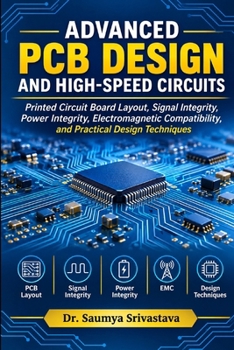
Advanced PCB Design and High-Speed Circuits: Printed Circuit Board Layout, Signal Integrity, Power Integrity, Electromagnetic Compatibility, and Pract
No Customer Reviews

Every electronic product that matters to modern life - the smartphone in a pocket, the server rack in a data centre, the ventilator in a hospital, the driver-assistance computer in a car - ultimately rests on a printed circuit board. For decades, the board was treated as little more than a mechanical carrier: a place to solder components and connect them with copper. That view stopped being true the moment signal edges became faster than the time it takes light to cross a few centimetres of laminate. Today the board is itself a circuit element: a distributed network of transmission lines, capacitors, inductors, antennas and heat spreaders, whose behaviour decides whether a design works, whether it passes regulatory testing, and whether it survives in the field.
This book was written to teach that board-level physics and the engineering practice that follows from it. It is organised around four ideas that every advanced designer must hold at once. The first is layout: the geometry of copper, dielectric, vias and components, which fixes every electrical property of the interconnect. The second is signal integrity: the discipline of making a signal arrive at its receiver with enough voltage and timing margin to be read correctly. The third is power integrity: the discipline of delivering clean, stable energy to every active device, at every frequency, under every load transient. The fourth is electromagnetic compatibility: the discipline of ensuring that the product neither disturbs other equipment nor is disturbed by it. These four views are not separate subjects; they are four projections of one underlying electromagnetic problem, and this book treats them that way.
Who this book is for
The text is intended for final-year undergraduate and postgraduate students in electronics, electrical, communication and computer engineering, for practising hardware designers who want a rigorous foundation behind the design rules they already follow, and for researchers who need a coherent reference to the interconnect problem. A working knowledge of circuit analysis, basic electromagnetics and digital electronics is assumed. Where more advanced mathematics is required - for example, for transmission-line theory or scattering parameters - the necessary results are derived or motivated from first principles, and worked examples show how to use them.
Every electronic product that matters to modern life - the smartphone in a pocket, the server rack in a data centre, the ventilator in a hospital, the driver-assistance computer in a car - ultimately rests on a printed circuit board. For decades, the board was treated as little more than a mechanical carrier: a place to solder components and connect them with copper. That view stopped being true the moment signal edges became faster than the time it takes light to cross a few centimetres of laminate. Today the board is itself a circuit element: a distributed network of transmission lines, capacitors, inductors, antennas and heat spreaders, whose behaviour decides whether a design works, whether it passes regulatory testing, and whether it survives in the field.
Format:Paperback
Language:English
ISBN:B0HQ44TWCW
ISBN13:9798167165489
Release Date:November 2026
Publisher:Independently Published
Length:272 Pages
Weight:0.81 lbs.
Dimensions:0.6" x 6.0" x 9.0"
Customer Reviews
0 rating
Copyright © 2026 Thriftbooks.com
Terms of Use | Privacy Policy | Do Not Sell/Share My Personal Information | Cookie Notice | Cookie Preferences | Accessibility Statement
ThriftBooks ® and the ThriftBooks ® logo are registered trademarks of Thrift Books Global, LLC
ThriftBooks ® and the ThriftBooks ® logo are registered trademarks of Thrift Books Global, LLC
