


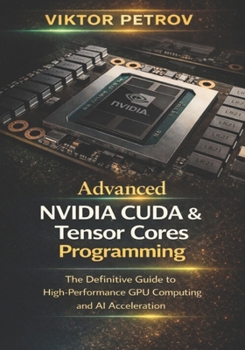
Advanced NVIDIA CUDA & Tensor Core Programming: The Definitive Guide to High-Performance GPU Computing and AI Acceleration

Most books about GPU computing stop at syntax. This one starts where the real work begins.
Over the years, I've watched talented engineers hit invisible ceilings - kernels that should scale but don't, models that stall without explanation, hardware that looks powerful on paper yet refuses to deliver in practice. The gap is rarely in the math. It lives in the layers beneath: the scheduler, the memory partitions, the instruction stream, the subtle architectural decisions that shape every cycle.
This book is a guided descent into that layer.
You will learn how to read PTX and SASS with architectural intent, design Tensor Core pipelines that sustain throughput under real training loads, eliminate serialization in reductions, diagnose warp stalls with precision, and build production-grade GEMMs that stand confidently next to vendor libraries. From Ampere to Hopper and beyond, each chapter focuses on how the hardware actually behaves - and how to shape your code to match it.
If you build deep learning systems, high-performance kernels, or infrastructure that must scale across GPUs and nodes, this book will change how you think about execution. You won't just write faster code. You'll understand why it is fast - and how to keep it that way as architectures evolve.
Customer Reviews
ThriftBooks ® and the ThriftBooks ® logo are registered trademarks of Thrift Books Global, LLC
