


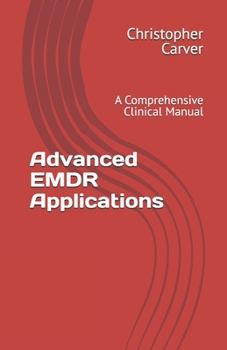
Advanced EMDR Applications: A Comprehensive Clinical Manual

Advanced EMDR Therapy is a clinically rigorous manual written for therapists who already understand the fundamentals of EMDR and are seeking greater precision, safety, and depth in complex trauma treatment.
This is not a book about doing EMDR faster.
It is a book about doing EMDR with discipline, restraint, and nervous-system intelligence.
Drawing on the Adaptive Information Processing (AIP) model, polyvagal theory, and parts-informed clinical judgment, this manual reframes advanced EMDR as a state-dependent, ethically paced process rather than a technique-driven protocol. It addresses the realities clinicians face when working with developmental trauma, attachment injury, dissociation, complex PTSD, and high-risk presentations-where traditional event-based targeting and linear progression often fail.
The text provides a phase-by-phase advanced framework that emphasizes:
Nervous system readiness over motivation or insight
Stabilization as neural preparation, not avoidance
Target selection based on integration capacity rather than intensity
Somatic and state-based decision-making throughout processing
Closure and reevaluation as core protective interventions
Rather than offering scripts or shortcuts, Advanced EMDR Therapy trains clinicians to read state shifts, interpret protective responses accurately, and intervene only when adaptive information processing is biologically available. Clinical pacing, ethical restraint, and therapist self-regulation are treated as essential competencies, not optional skills.
This manual is especially suited for clinicians who:
Work with complex or developmental trauma
Encounter dissociation, structural blocking, or post-session destabilization
Struggle with determining readiness versus avoidance
Want clearer decision rules for pacing, sequencing, and closure
Seek a deeper understanding of why EMDR works-and when it does not
Written as both a reference and a clinical companion, Advanced EMDR Therapy supports therapists in moving beyond protocol compliance toward integrative, nervous-system-informed trauma treatment that prioritizes safety, durability, and ethical care.
Related Subjects
PsychologyCustomer Reviews
ThriftBooks ® and the ThriftBooks ® logo are registered trademarks of Thrift Books Global, LLC
