


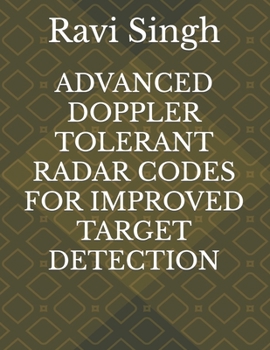
Advanced Doppler Tolerant Radar Codes for Improved Target Detection
No Customer Reviews

Advances in technologies in fighter aircrafts, missiles and ICBMs have forced the Radar
and Communication Engineering research community to consistently pay attention to
detect and locate the fast moving targets from the static radar using extremely sensitive
receivers which are often inherited with noise. State of art works mainly use matched
filter (autocorrelation) of the received signal with delayed sample of transmitted signal to
increase the amplitude of the main lobe. However this process introduces side lobe which
is the main cause for the loss of energy. The pulse compression technique combines the
advantage of high energy of a long pulse giving adequate range with the high resolution
of a short pulse. This process is helpful in getting ample power transmitted for the radar
for long ranges and the range resolution of a small pulse at the same time. It is
comparatively easy to detect the targets when it is stationary, and sidelobes at the output
of merit factor can be made zero using various techniques. The masking of moving targets
by the side lobe as a result of autocorrelation or the matched filtering hampers the
detection of dangerously small fast moving targets like fighter aircrafts, drones and
missiles etc.
Continuous research to increase the Signal to Noise Ratio (SNR), Merit Factor (MF) and
Integrated Side Lobe Ratio (ISLR) also called discrimination factor were attempted by
many authors. Barker codes gave good MF and ISLR by restricting the side lobe to the
value of one but barker codes were limited to a maximum length of 13. Minimum peak
side lobe codes were attempted by many researchers using various optimizing techniques
like Simulated Annealing, Bi-parental Product Algorithm, skew symmetric binary
sequences etc, but with multiple moving targets these approaches failed completely.
Attempts were also made to improve the SNR using nested barker codes, mismatched
filtering using longer binary codes by zero padding, Costas and many other codes,
windowing functions etc, however the problem of addressing the Doppler was still at
large. PTM codes have been introduced to give clear window at zero or low Doppler values,
where targets could be detected. Golay codes transmitted in PTM sequences have been
reported to give better results considering oversampled codes. However the same could
not be adopted easily for fast moving targets.
In this thesis we initially start with the development of binary codes, to increase the merit
factor. However these approaches are good for stationary targets and slow moving targets.
The main objective is to develop codes to eliminate the side lobs and improve detection of
multiple moving targets. We have attempted to develop the new set of binary codes which
helps to create clear windows at desired Doppler to detect multiple fast moving targets
with varying Doppler at different ranges. The sidelobes of the autocorrelation in these
windows are very low for entire range of the radar giving very good detection.
The work done in this thesis brings about a conceptual change in detection process by
creating Doppler windows at various frequencies for which detection is easy for the entire
range of radar. These windows can be created at the desired Doppler in which the noise
amplitude is very low and this makes the detection process very easy without ambiguity.
Many techniques using binary and hex codes have been developed to create windows in
Doppler where the noise levels are very low and these Doppler windows can be easily
created at any desired Doppler. Entire practical range of Doppler frequencies based on
target speeds has been covered and many approaches have been designed to create very
low noise in these windows to enhance detection. Fast moving targets at various Doppler
can be detected in multiple target scenarios.
and Communication Engineering research community to consistently pay attention to
detect and locate the fast moving targets from the static radar using extremely sensitive
receivers which are often inherited with noise. State of art works mainly use matched
filter (autocorrelation) of the received signal with delayed sample of transmitted signal to
increase the amplitude of the main lobe. However this process introduces side lobe which
is the main cause for the loss of energy. The pulse compression technique combines the
advantage of high energy of a long pulse giving adequate range with the high resolution
of a short pulse. This process is helpful in getting ample power transmitted for the radar
for long ranges and the range resolution of a small pulse at the same time. It is
comparatively easy to detect the targets when it is stationary, and sidelobes at the output
of merit factor can be made zero using various techniques. The masking of moving targets
by the side lobe as a result of autocorrelation or the matched filtering hampers the
detection of dangerously small fast moving targets like fighter aircrafts, drones and
missiles etc.
Continuous research to increase the Signal to Noise Ratio (SNR), Merit Factor (MF) and
Integrated Side Lobe Ratio (ISLR) also called discrimination factor were attempted by
many authors. Barker codes gave good MF and ISLR by restricting the side lobe to the
value of one but barker codes were limited to a maximum length of 13. Minimum peak
side lobe codes were attempted by many researchers using various optimizing techniques
like Simulated Annealing, Bi-parental Product Algorithm, skew symmetric binary
sequences etc, but with multiple moving targets these approaches failed completely.
Attempts were also made to improve the SNR using nested barker codes, mismatched
filtering using longer binary codes by zero padding, Costas and many other codes,
windowing functions etc, however the problem of addressing the Doppler was still at
large. PTM codes have been introduced to give clear window at zero or low Doppler values,
where targets could be detected. Golay codes transmitted in PTM sequences have been
reported to give better results considering oversampled codes. However the same could
not be adopted easily for fast moving targets.
In this thesis we initially start with the development of binary codes, to increase the merit
factor. However these approaches are good for stationary targets and slow moving targets.
The main objective is to develop codes to eliminate the side lobs and improve detection of
multiple moving targets. We have attempted to develop the new set of binary codes which
helps to create clear windows at desired Doppler to detect multiple fast moving targets
with varying Doppler at different ranges. The sidelobes of the autocorrelation in these
windows are very low for entire range of the radar giving very good detection.
The work done in this thesis brings about a conceptual change in detection process by
creating Doppler windows at various frequencies for which detection is easy for the entire
range of radar. These windows can be created at the desired Doppler in which the noise
amplitude is very low and this makes the detection process very easy without ambiguity.
Many techniques using binary and hex codes have been developed to create windows in
Doppler where the noise levels are very low and these Doppler windows can be easily
created at any desired Doppler. Entire practical range of Doppler frequencies based on
target speeds has been covered and many approaches have been designed to create very
low noise in these windows to enhance detection. Fast moving targets at various Doppler
can be detected in multiple target scenarios.
Format:Paperback
Language:English
ISBN:B0CDYXFFLL
ISBN13:9798856206158
Release Date:August 2023
Publisher:Independently Published
Length:146 Pages
Weight:0.78 lbs.
Dimensions:0.3" x 8.5" x 11.0"
Customer Reviews
0 rating
Copyright © 2026 Thriftbooks.com Terms of Use
| Privacy Policy | Do Not
Sell/Share My Personal Information | Cookie Policy | Cookie Preferences | Accessibility Statement
ThriftBooks® and the ThriftBooks® logo are registered trademarks of Thrift Books Global, LLC
ThriftBooks® and the ThriftBooks® logo are registered trademarks of Thrift Books Global, LLC
