


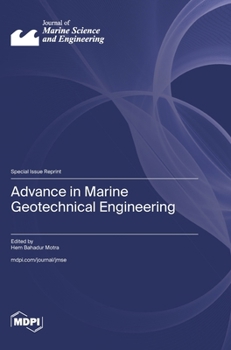
Advance in Marine Geotechnical Engineering
No Customer Reviews

Marine geotechnical engineering has evolved rapidly in recent years, driven by growing demands for offshore energy, coastal protection, and seabed infrastructure. Key advances include improved site investigation methods, including using high-resolution in situ testing, remote sensing, geophysical surveys, and 3D spatial statistical modelling (e.g., frameworks that account for anisotropy and non-stationarity in seabed sediment properties).
Format:Hardcover
Language:English
ISBN:3725869200
ISBN13:9783725869206
Release Date:March 2026
Publisher:Mdpi AG
Length:262 Pages
Weight:1.69 lbs.
Dimensions:0.9" x 6.7" x 9.6"
Customer Reviews
0 rating
Copyright © 2026 Thriftbooks.com
Terms of Use | Privacy Policy | Do Not Sell/Share My Personal Information | Cookie Policy | Cookie Preferences | Accessibility Statement
ThriftBooks ® and the ThriftBooks ® logo are registered trademarks of Thrift Books Global, LLC
ThriftBooks ® and the ThriftBooks ® logo are registered trademarks of Thrift Books Global, LLC
