


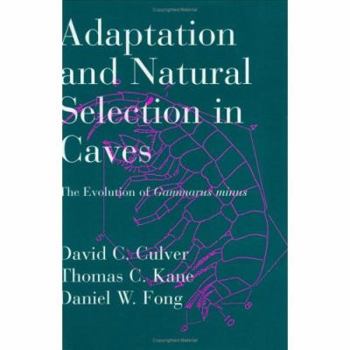
Adaptation and Natural Selection in Caves: The Evolution of Gammarus minus


The harsh environment of caves - dark, damp, sparse of food - is home to a variety of bizarre creatures. Biologists, for their part, often treat these delicate, colourless organisms with no eyes, or at least greatly reduced eyes, as mere oddities with little importance to a topic as grand as evolution. Focusing on one cave-dwelling crustacean, Gammarus minus, this book shows that, to the contrary, cave life can provide a valuable empirical model for the study of evolution, particularly adaptation.
Format:Hardcover
Language:English
ISBN:0674004256
ISBN13:9780674004252
Release Date:March 1995
Publisher:Harvard University Press
Length:223 Pages
Weight:1.10 lbs.
Dimensions:9.3" x 0.9" x 6.1"
Customer Reviews
2 ratings
Evolutionary Biology - A Subterranean Study
Published by Thriftbooks.com User , 23 years ago
The evolution of Gammarus minus is the subject of a remarkably interesting text published by Harvard University Press. Gammarus who? Gammarus what? Gammarus minus is a little freshwater crustacean, an isopod, that inhabits surface streams, springs, and caves. We all have some knowledge of the theory of natural selection and evolution, and yet, I suspect that few fully recognize the complexity and difficulty in conducting research in evolutionary biology. Just how does one go about proving or disproving some aspect of evolutionary theory? David Culver, Thomas Kane, and Daniel Fong argue that caves and cave animals are valuable empirical models for the study of evolution, particularly for the study of adaptation. The unusual morphology of cave fauna makes them "quintessential examples of evolutionary tradeoffs, a recurring theme in the study of adaptation". Also, as the cave environment is more uniform and less complex than most habitats, the analysis of environmental effects on selection is accordingly less difficult. And convergent evolution in many isolated cave systems offers a degree of repeatability that is often absent in evolutionary studies. This text, Adaptation and Natural Selection in Caves, is remarkably well-organized and clearly written, and is accessible to the layman interested in cave biology and ecology. However, I caution the reader. This is not a popular book on evolution for the layman. This is a detailed, well-documented, thoughtful, multidisciplinary scientific study whose primary audience is active researchers and graduate students in the biological sciences. Evolutionary biology requires a wide background. The reader will encounter biospeleology, ecology, electrophoresis, genetics, isopod morphology, karst geology, stream hydraulics, and systematics. As advanced statistical techniques are commonly used in genetic and evolutionary studies, the reader will meet the F statistic, dendrograms, k-means clustering, rank-3 biplots, correlation matrices, and short discussions on determining the optimal splines for curve fitting. The glossary was quite helpful with terms like adaptive radiation, allozyme, apomorphic, exaptation, electrophoresis, gene flow, homoplasy, neoteny, and vicariance. While this text may require some persistence, it is well-worth the effort. I commend Culver, Kane, and Fong for providing an intriguing look at a complex, interdisciplinary research topic. I recommend first reading, chapter by chapter, the concise introductions and the concluding summaries. Then return to the beginning of the book to study the chapters in more detail. The summaries are clearly written and allow the reader to quickly and easily develop an overview of each chapter. As a final comment, Adaptation and Natural Selection in Caves would be an excellent choice for a reading assignment for undergraduates in biology, ecology, genetics, morphology, and limnology. Culver, Kane, and Fong clearly answer the question: Just how doe
A truly unique study in the field of evolution
Published by Thriftbooks.com User , 28 years ago
When it comes to evolution, almost anyone can quote Darwin's theory of natural selection...but how many people set out to prove it? In this book, the authors present the beginnings of tackling this ambitious task. Their approach is truly unique...rather than examining the diversity of all life, they have focused twenty-plus years of research on a tiny, rather obscure, cave crustacean. By drawing from numerous scienfific fields (ecology, systematics, mathematics, limnology, evolutionary theory, even molecular genetics) the authors have produced one of the most complete pictures of the effect of natural selection on a single animal. Amateur cavers might find the techical aspects of the book somewhat daunting, while expert scientists may view the study as too limitied -- yet both can appreciate the ramifications of what this study, of a little shrimp, might someday teach us about ourselves.
Copyright © 2026 Thriftbooks.com
Terms of Use | Privacy Policy | Do Not Sell/Share My Personal Information | Cookie Notice | Cookie Preferences | Accessibility Statement
ThriftBooks ® and the ThriftBooks ® logo are registered trademarks of Thrift Books Global, LLC
ThriftBooks ® and the ThriftBooks ® logo are registered trademarks of Thrift Books Global, LLC
