


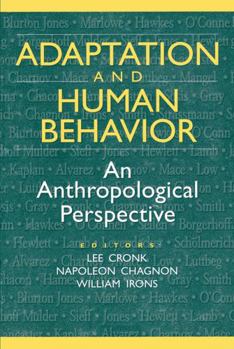
Adaptation and Human Behavior: An Anthropological Perspective

Select Format
Select Condition 
Book Overview
No detailed description available for "Adaptation and Human Behavior".
Format:Paperback
Language:English
ISBN:0202020444
ISBN13:9780202020440
Release Date:August 2000
Publisher:Routledge
Length:528 Pages
Weight:1.58 lbs.
Dimensions:1.3" x 6.0" x 9.1"
Customer Reviews
3 ratings
GREAT
Published by Thriftbooks.com User , 21 years ago
This book arrived in adequate time and was in great condition. There was no trouble with delivery, it was on time.
Another step forward for empirical science.
Published by Thriftbooks.com User , 25 years ago
This book brings together some of the best minds to discuss what weknow about evolutionary strategies for mating, parenting, reproductionand altruism. It consists of numerous studies showing the universalityof human behavior, and how different ecologies result in differentlocal behaviors, all the while conforming to our innate algorithms.That is, how nature and nurture combine resulting in our modernsocieties, and how our maladaptations with regards to rep[17~roductionand altruism are a result of our technology changing the rules ofadapted strategies. Such things as birth control have now unlinkedmale social displays of wealth and dominance that once led toreproductive success.But the best part of the book is the Statementof Theories. It is a lucid history of how cultural anthropology hasall but abandoned the scientific empiricism for a politically drivenagenda of cultural determinism. That is, while these radicalenvironmentalists were criticizing evolutionary approaches withoutcoming up with alternative theories, evolutionary theorists werecharging ahead, making phenomenal progress in understanding humannature. It explains again how detractors such as Sahlins, Gould,Lewontin, Kamin, Rose, et al., with their condemnation of theevolutionary perspective, without providing alternative hypotheses,have actually accelerated the progress made in linking humans to allother organisms in an evolutionary explanation of how we interact withthe world about us. [17~[17~[17~Overall, this book is mustreading, especially for anyone interested in demographics, parenting,and reproduction rates of different population groups. Especially nowwhen there is a renewed interest in many countries that reproductionrates are so low that immigration is sought to make up the difference,with the impending problems it brings when multiculturalism replaceshomogeneous populations and cultures.
Human Behavioral Ecology at its Finest
Published by Thriftbooks.com User , 25 years ago
The greatest error in social theory throughout the 20th century was the belief that humans are so different from other species that none of the tools normally used to study behavior in non-humans is applicable to the study of behavior in humans. Usually this was supported by arguing that human culture is so variable and human nature so malleable that we have virtually completely transcended our animal roots.E. O. Wilson's great book, Sociobiology (1975) changed all that. Despite ferocious opposition to the idea that humans are animals deeply affected by their evolutionary history (Wilson was called a racist and a fascist by very eminent biologists and anthropologists), a whole generation of young researchers got the message, and began producing extremely valuable studies confirming that many aspects of human psychology and human social organization could be better appreciated by treating humans as the product of evolution, and using methods little different from the study of primates, and even birds and insects.This book is an edited collection of some of the major research efforts undertaken by these evolutionary psychologists, sociobiologists, and behavioral ecologists. The research is for the most part not armchair theorizing, but the analysis of painfully collected and minutely analyzed data on small scale societies. After two chapters of nicely developed theory, the book offers five chapters on mating, followed by another five chapters on parenting.The book then attacks a major problem in sociobiology: the demographic transition, which occurred in Europe a century ago, and is occuring in many developing nations today. The demographic transition consists of a fall in the birth rate following a rise in per capital income---an event that is quite unexpected, since sociobiology is based on the notion that humans are/were in their evolutionary history, fitness maximizers. The most plausible explanation, offered by Kaplan and Lancaster, is that humans do not maximize fitness, but rather a combination of fitness and welfare. The implications of this for social theory are immense, and begin to draw sociobiology back into conformance with economic theory, which stresses utility maximization.The book then presents four papers on human sociality. These papers, while quite impressive, are to my mind excessively closely tied to Robert Triver's notion of reciprocal altruism, and more broadly, Richard Alexander's slightly broader notion of indirect altruism. I think recent evidence fairly conclusively shows that human behavior is not self-interested even in the widest sense, and some theory of multilevel selection and/or culture/gene coevolution is needed to explain human sociality in an acceptable manner.But these are quibbles on the edge of current research, and should by no means deter the interested reader from profiting from these exciting and impressive articles.
Copyright © 2026 Thriftbooks.com
Terms of Use | Privacy Policy | Do Not Sell/Share My Personal Information | Cookie Policy | Cookie Preferences | Accessibility Statement
ThriftBooks ® and the ThriftBooks ® logo are registered trademarks of Thrift Books Global, LLC
ThriftBooks ® and the ThriftBooks ® logo are registered trademarks of Thrift Books Global, LLC
