


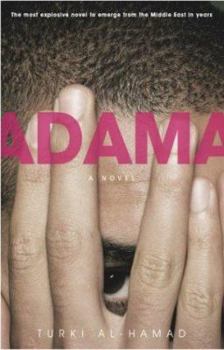



Book Overview
In his tranquil middle-class neighbourhood, eighteen-year-old Hisham doesn't quite fit in. He's a budding philosopher who spends his days reading banned books and developing his political ideals. His... This description may be from another edition of this product.
Format:Hardcover
Language:English
ISBN:1886913609
ISBN13:9781886913608
Release Date:September 2003
Publisher:Ruminator Books
Length:300 Pages
Weight:1.10 lbs.
Dimensions:8.3" x 0.5" x 5.5"
Customer Reviews
4 ratings
A sublime evocation of an era
Published by Thriftbooks.com User , 20 years ago
Turki al-Hamad's "Adama" is the first instalment in a trilogy dealing with the coming-of-age of Hisham al-Abir, a young Saudi boy, during the 1960s. The novel and its author have been rather controversial in the Gulf states since its publication, however this should not discourage readers. "Adama" deals with Hisham's early experiences in relation to radical ideas - those of Marx, Engels, Lenin and such - during the era in which many young Arab students came to hold the belief that religious-based regimes were not the way forward and that secular nationalism was equal to progress. Unsurprisingly, particularly in Saudi Arabia, this was a political belief which had to be kept quiet for fear of arousing the suspicion of the authorities. Keeping quiet is what Hisham does, secretly joining a clandestine organisation - the Ba'ath Party - and distributing leaflets around his school. At the same time, his parents are putting pressure on him to study for a career which will bring in money, such as medicine or commerce, which would require him to leave the Eastern Province of the kingdom and travel to the national capital - Riyadh. The story is told in an unusual elliptical style, and one wonders in passing if this is perhaps a Joycean device which has been appropriated here. This may ultimately be too long a bow to draw, however. Many of the short chapters take place in the recent past and are prompted by Hisham's memories of the events which led him to his current position. Occasionally, this proves slightly disconcerting for the reader, however it is ultimately a technique which works well. Turki al-Hamad's real strength lies in his evocation of the place and time of the novel. His 1960s Saudi Arabia leaps off the page with its dust, sand and oil wealth. Indeed, readers who have experienced the modern Gulf states will be interested by how little difference there really is in many ways. His characters, particularly Hisham, have a vibrancy as well. As befits a coming-of-age novel, Hisham's inner life is dealt with in considerable detail, however this is anything but boring. Readers of other works of Arabic literature will particularly notice Hisham's dream sequence in which he meets with characters such as Ahmad al-Jawad of Naguib Mahfouz's masterful Cairo Trilogy. Indeed, the question must be asked if Turki is Naguib's equal. To that, a satisfactory answer cannot yet be given, as Naguib has a much greater corpus of work. On the strength of his current technique, however, Turki may well find himself in such illustrious company quite soon. The other great strength of "Adama" is the subtle humour. Despite the restrictions placed on their lives, Hisham and his friends still live just like the normal teenagers they are. Hisham's furtive attempts at romance are the kinds of things which any young man would experience the world over, they just happen to be with young women he would not normally have contact with. Turki relates these events in a very charming
Page turner ...
Published by Thriftbooks.com User , 20 years ago
This book has enriched my life and really inspired me in different ways. After I finished reading Shumaisi,the 2nd part of the series, I went driving around Shumaisi ( which is an old neighborhood in Riyadh) trying to catch some of the essence of the novel .. it was unbelievable the amount of feelings i was surrounded by. the three books made a huge controversy here in Saudi among the extremest Wahhabi and also among the different layers of the society. Dr. Turky got a huge amount of bad mouthing and criticism that focused on his personal life away from criticising the work he has done. I think Turky Alhamad opened the eyes of the people and started the real first step into reforms in Saudi Arabia.
Insider's View
Published by Thriftbooks.com User , 21 years ago
The first in a trilogy, Adama is an insider's view of growing up in Saudi Arabia in the years following Israel's victory in the 1967 Six Day War. Hisham, an idealistic high school student from a middle-class neighborhood of Riyadh, is preparing for his university exams. Despite his parents' wish that he become a doctor, or least an engineer, he chooses history and political theory instead. His fateful decision first leads to reading the great books of the West. Encouraged by a young teacher, Hisham devours the works of Che Guevara, Engels, and Lenin. He then moves on to nineteenth century Arab nationalists, Marxists, and existentialists. Before long the outlawed Arab Socialist Ba'ath Party recruits Hisham as a "freedom fighter," working for the defeat of not only Israel, but also the Saudi government. However, Hisham quickly becomes disenchanted with his comrades' uncritical, and often comical, faith in Arab unity and revolution. The journey from rebellion to disillusion is a cherished theme in Western literature. But throughout the Middle East, authoritarian regimes have banned Adama while the conservative Islamic establishment has issued four fatwas against al-Hamad. Regardless, or perhaps because of this, Adama has become a widely popular underground novel. For Western readers, it offers a deeply humane portrait of a generation, weighed down by traditional social forces and corrupt politics, struggling to create a truly democratic society. That such a generation exists expressing itself through authors like al-Hamad should give us cautious hope about the future of the Middle East.
"What would be left of life if we stripped it of feeling?"
Published by Thriftbooks.com User , 22 years ago
As fascinating as this book is for its glimpses of a young man's political and philosophical coming-of-age in Saudi Arabia, it is equally fascinating for what its banning reveals about the several countries which have tried to suppress it. Few western readers will find anything really incendiary here. No specific criticism is made of any individual nations or governments, and the political debate which features so prominently in the action is characteristic of young college students around the world. Yet several Middle Eastern countries have banned it, and four fatwas calling for the death of the author have been issued. Published in the Middle East in 1998, this novel recreates the awakening of a bright and idealistic Arab student to intellectual and political realities. Hisham al-Abir is only fourteen when a young teacher first inspires him to think critically, and he soon begins to read voraciously in history, political theory, philosophy, and literature. He devours works by nineteenth century Arab nationalists, Marxists, and existentialists, and studies the French Revolution and the Napoleonic Wars. Writings by Che Guevara, Engels, and Lenin compete for his attention with literature by Dostoevsky, Tolstoy, Gorky, and even Dickens, Pearl Buck, and Flaubert, and he becomes an active debater in his school. Contacts made by an older student and by the school monitor soon lead him to become a "freedom fighter" and member of the Arab Socialist Baath Party, a clandestine organization dedicated to resisting oppression, though he is told, ironically, "Anything I say you must do immediately without discussion. Act first, talk later." It is not long before his exposure to competing ideas causes him to question his commitment to the movement.Al-Hamad's novel humanizes young men like Hisham, showing his aspirations to many of the same goals as the rest of us. His love for his family, his desire to honor his parents, his idealism, his natural curiosity about the opposite sex, and his commitment to his own heritage show him to be like teenagers around the world. His unquenchable thirst for knowledge of the wider world brings him into direct conflict with the needs of those in power, however, and the author successfully conveys the emotions of this young man and the disillusionment he feels. While the book is a bit didactic and the plot somewhat predictable by western standards, it may offer new realms of thought to the young people who obtain it via the underground in the Middle East. Those of us reading this book in English will appreciate anew the freedom of the press, while perhaps gaining new insights into the conflict between ideas and reality in other parts of the world. Mary Whipple
Copyright © 2026 Thriftbooks.com Terms of Use
| Privacy Policy | Do Not
Sell/Share My Personal Information | Cookie Policy | Cookie Preferences | Accessibility Statement
ThriftBooks® and the ThriftBooks® logo are registered trademarks of Thrift Books Global, LLC
ThriftBooks® and the ThriftBooks® logo are registered trademarks of Thrift Books Global, LLC
