


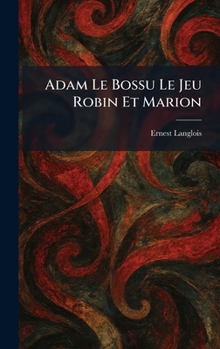
Adam Le Bossu Le Jeu Robin Et Marion

"Le Jeu de Robin et Marion" stands as one of the most significant works of medieval literature, often cited as the first French secular play with music. Composed in the 13th century by the renowned trouv re Adam de la Halle, also known as Adam le Bossu, this pastoral drama transforms the traditional pastourelle poetic form into a vibrant theatrical experience. The story centers on the steadfast shepherdess Marion, who must navigate the unwanted advances of a passing knight while maintaining her devotion to her rustic suitor, Robin.
This edition, edited by the distinguished scholar Ernest Langlois, presents the work's delicate balance of spoken dialogue, song, and dance. Through its depiction of rural life and courtly intrusion, the play offers profound insights into the social structures and artistic sensibilities of the Middle Ages. "Le Jeu de Robin et Marion" is not only a milestone in the development of comic opera but also a charming testament to the lyrical genius of the medieval period. It remains a vital text for those interested in the history of theater, musicology, and early Romance languages.
This work has been selected by scholars as being culturally important, and is part of the knowledge base of civilization as we know it. This work was reproduced from the original artifact, and remains as true to the original work as possible. Therefore, you may see the original copyright references, library stamps (as most of these works have been housed in our most important libraries around the world), and other notations in the work.
This work is in the public domain in the United States of America, and possibly other nations. Within the United States, you may freely copy and distribute this work, as no entity (individual or corporate) has a copyright on the body of the work.
As a reproduction of a historical artifact, this work may contain missing or blurred pages, poor pictures, errant marks, etc. Scholars believe, and we concur, that this work is important enough to be preserved, reproduced, and made generally available to the public. We appreciate your support of the preservation process, and thank you for being an important part of keeping this knowledge alive and relevant.
Customer Reviews
ThriftBooks® and the ThriftBooks® logo are registered trademarks of Thrift Books Global, LLC
