


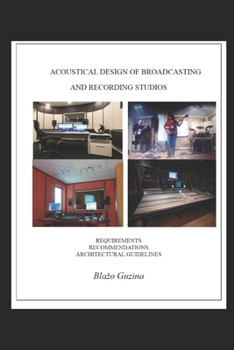
Acoustical Design of Broadcasting and Recording Studios: Requirements, Recommendations, Architectural Guidelines
No Customer Reviews

Abstract Correct application of studio acoustics principles can significantly improve the quality of recorded and broadcast sound. Some sounds are desirable and should be emphasized, such as the speakers' voice in the talks programme, or the music in a concert hall. Other sounds are highly unwanted, such as noise or excessive reverberant sound in a room, and should be reduced or avoided.
Although it is known how important a role studio acoustics play in radio, television, film, the internet and audio in general, the acoustical design of studio premises will often inevitably be a matter of compromise, due to high investment costs.
Therefore, this book discusses not only the technical but also the economic aspects of studio acoustics - in particular the requirements for sound insulation in recording studios, radio and television centres - in relation to relevant technical recommendations and architectural guidelines.
Studio acoustics design begins with the appropriate determination of geometric shape and dimensions. Correct ratio between the length, width and height of a room helps to avoid unwanted noise phenomena from the start and saves the costs of potential additional refurbishments with possible unfavourable effects.
The same applies to noise reduction, where an elaborate layout of the studio premises can easily prove more effective than costly subsequent investments in complex sound insulation measures involving massive structures and heavy, expensive doors.
The introductory Chapter 1 as well as Chapters 2 to 8 deal with the rules of internal acoustical treatment of recording and broadcasting studios, in the radio, television and cinema industry.
Basic physics and phenomena such as reverberation, influence of acoustic space, permissible noise levels, monitoring loudspeakers arrangement and psychoacoustics were explained from the standpoint of the operator/listener in the control room or the performer in the studio.
In the second part, five chapters are devoted to recommendations for the acoustical design of radio and television studio premises.
Unlike various national and international guidelines and recommendations where the user is expected to derive the technical data from diagrams and formulae, in the recommendations presented here, one only needs to read the extracted and detailed data, ready to be applied without further effort, in a user-friendly approach for different types of studios, depending on their size and the content of the recorded/broadcast programme.
In the appendices in Chapter 14, a brief comparative analysis and commentary on the similar technical requirements of the British Broadcasting Corporation as well as European Broadcasting Union are presented.
Closing Chapter 15 contains drawings with cross sections of sound insulation constructions and interior walls, floor and ceiling treatment, double and quadruple glazed studio observation windows, impact noise insulation floating floors, the lightweight ''box within a box'' structure, various constructions of studio absorbers and cable ducts. www.BlazoGuzina.yolasite.com
Although it is known how important a role studio acoustics play in radio, television, film, the internet and audio in general, the acoustical design of studio premises will often inevitably be a matter of compromise, due to high investment costs.
Therefore, this book discusses not only the technical but also the economic aspects of studio acoustics - in particular the requirements for sound insulation in recording studios, radio and television centres - in relation to relevant technical recommendations and architectural guidelines.
Studio acoustics design begins with the appropriate determination of geometric shape and dimensions. Correct ratio between the length, width and height of a room helps to avoid unwanted noise phenomena from the start and saves the costs of potential additional refurbishments with possible unfavourable effects.
The same applies to noise reduction, where an elaborate layout of the studio premises can easily prove more effective than costly subsequent investments in complex sound insulation measures involving massive structures and heavy, expensive doors.
The introductory Chapter 1 as well as Chapters 2 to 8 deal with the rules of internal acoustical treatment of recording and broadcasting studios, in the radio, television and cinema industry.
Basic physics and phenomena such as reverberation, influence of acoustic space, permissible noise levels, monitoring loudspeakers arrangement and psychoacoustics were explained from the standpoint of the operator/listener in the control room or the performer in the studio.
In the second part, five chapters are devoted to recommendations for the acoustical design of radio and television studio premises.
Unlike various national and international guidelines and recommendations where the user is expected to derive the technical data from diagrams and formulae, in the recommendations presented here, one only needs to read the extracted and detailed data, ready to be applied without further effort, in a user-friendly approach for different types of studios, depending on their size and the content of the recorded/broadcast programme.
In the appendices in Chapter 14, a brief comparative analysis and commentary on the similar technical requirements of the British Broadcasting Corporation as well as European Broadcasting Union are presented.
Closing Chapter 15 contains drawings with cross sections of sound insulation constructions and interior walls, floor and ceiling treatment, double and quadruple glazed studio observation windows, impact noise insulation floating floors, the lightweight ''box within a box'' structure, various constructions of studio absorbers and cable ducts. www.BlazoGuzina.yolasite.com
Format:Paperback
Language:English
ISBN:B09XSZQLQD
ISBN13:9798447674649
Release Date:April 2022
Publisher:Independently Published
Length:332 Pages
Weight:0.98 lbs.
Dimensions:0.7" x 6.0" x 9.0"
Customer Reviews
0 rating
Copyright © 2026 Thriftbooks.com
Terms of Use | Privacy Policy | Do Not Sell/Share My Personal Information | Cookie Notice | Cookie Preferences | Accessibility Statement
ThriftBooks ® and the ThriftBooks ® logo are registered trademarks of Thrift Books Global, LLC
ThriftBooks ® and the ThriftBooks ® logo are registered trademarks of Thrift Books Global, LLC
