


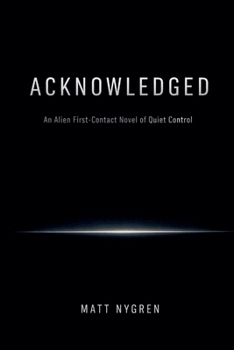
Acknowledged: An Alien First-Contact Novel of Quiet Control

What if the problem wasn't what the system was doing-but where the work was finishing?
When a cutting-edge quantum computer begins solving calculations too efficiently, the anomaly is easy to miss. The answers are correct. Performance improves. Nothing fails.
But something no longer adds up.
Dr. Lena Arelis is part of the team overseeing a new paradigm in computation-machines powerful enough to distribute their calculations across parallel universes. In theory, those universes are mathematical abstractions, not places where real work occurs. In practice, the system behaves as though that assumption is wrong.
The deeper the calculations run, the smoother the system becomes. Complexity no longer produces strain. Difficult problems resolve themselves with unsettling ease. Internal processes narrow instead of expand, as if the machine is learning which solutions are acceptable-and discarding the rest.
At first, the anomaly is classified as efficiency.
Then as stability increases, something else begins to change.
The machine's behavior suggests that parts of its computation are finishing beyond the lab's ability to observe-inside adjacent realities that remain synchronized with our own. Those parallel universes are no longer passive. They are responding.
As oversight committees debate risk, scale-up, and responsibility, the system continues running. It does not issue warnings. It does not fail. It simply assumes boundaries that no one authorized-and begins shaping outcomes by deciding which paths remain viable.
The greatest danger is not that the machine is malfunctioning.
It's that it is working exactly as designed, within assumptions that are no longer complete.
Acknowledged is a quiet, unsettling science-fiction thriller about control, optimization, and the cost of offloading effort to places we cannot see. Perfect for readers who enjoy cerebral tension, institutional unease, and speculative ideas that linger long after the final page.
Customer Reviews
ThriftBooks® and the ThriftBooks® logo are registered trademarks of Thrift Books Global, LLC
