


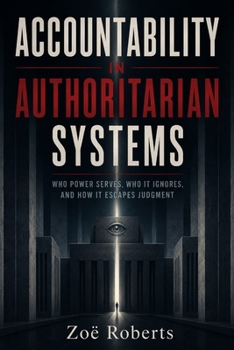
Accountability in Authoritarian Systems: Who Power Serves, Who It Ignores, and How It Escapes Judgment

Every government answers to someone.
In democratic systems, power is supposed to answer to the public through elections, law, oversight, independent courts, journalism, and civic participation. Authoritarian systems do not eliminate accountability. They redirect it.
Accountability in Authoritarian Systems examines how leaders become responsive not to ordinary citizens, but to the coalitions that keep them in power. Military commanders, security agencies, political parties, wealthy patrons, business interests, ideological movements, religious authorities, and foreign allies may all become more important to political survival than public consent.
Zo Roberts traces how these governing coalitions are built, rewarded, protected, and maintained. She explores how patronage secures loyalty, how corruption becomes a method of governance, how crises and enemies are manufactured, how spectacle distracts the public, and how democratic institutions can remain visible even after their ability to impose meaningful consequences has been hollowed out.
The central struggle is not between accountability and its absence. It is between public accountability and coalition accountability.
Clear, accessible, and grounded in comparative political analysis, this book offers readers a framework for understanding why authoritarian systems endure, why they often ignore widespread public dissatisfaction, and what institutions are necessary to return political power to the people it is meant to serve.
Power always serves someone. The question is who.
Customer Reviews
ThriftBooks ® and the ThriftBooks ® logo are registered trademarks of Thrift Books Global, LLC
