


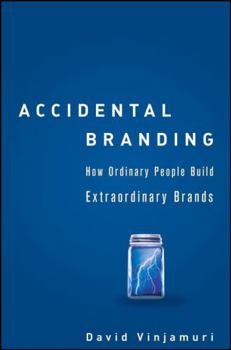
Accidental Branding: How Ordinary People Build Extraordinary Brands

Every year, thousands of new business are started by people with no knowledge of modern marketing at all'and some of them survive and thrive. Accidental Branding tells the story of seven "accidental" brands and how their founders beat bigger competitors by breaking the standard rules of marketing. Successful brands like Burt's Bees, J. Peterman, and Clif Bar reveal how doing things differently can lead to big-time success. If you're an entrepreneur or a marketer, this guide will show you how to build stronger brands.
Format:Hardcover
Language:English
ISBN:0470165065
ISBN13:9780470165065
Release Date:March 2008
Publisher:Wiley
Length:212 Pages
Weight:0.90 lbs.
Dimensions:0.8" x 6.4" x 8.9"
Customer Reviews
5 ratings
Inspiring for Marketers and Entrepreneurs
Published by Thriftbooks.com User , 17 years ago
Once, I was reading Accidental Branding on the subway and two twenty-ish European women sitting by me paused to check out the book. "It's an interesting title," said the brunette. The next day I was at UPS and a 30-something mother entered with her three-year-old. She asked to see the book, as it turned out she had Thanksgiving dinner with the author. Later, I went to The Art of Shaving. This wasn't so accidental, as the company is prominently featured in the book as one of seven "accidental brands," which means it fits three criteria, according to author David Vinjamuri: 1. It was created by someone not trained in marketing. 2. The creator must experience the problem the brand solved (eg the co-founder of Art of Shaving experienced nasty razor burn). 3. The individual must control the brand for at least 10 years. I was so captivated by the story of Shaving founders Myriam Zaoui and Eric Malka and so troubled over my own inability to get a decent shave that, as I was finishing the book, I took the subway to the nearest Art of Shaving store on East 62nd Street, the original store they opened. As the book hadn't been released yet, the store manager Angelo wasn't aware of it, but he was excited to glance at the chapter featuring his store. Fifteen minutes later, I learned enough from Angelo to attempt to try a new way of shaving at home, spending more than I ever have in my life on skin care products in the process. Now, that has much more to do with the brand than the book, but it also gets to what makes the book so compelling. Vinjamuri tells seven stories of accidental brands: J. Peterman, craigslist, Clif Bar, The Art of Shaving, Columbia Sportswear, Baby Einstein, and Burt's Bees. Perhaps more than any individual brand's story, I'll remember the storytelling. Each story's told with affection, and the tone shifts ever so slightly for each one, from the wilderness of Peterman to the trailblazing Clif Bar to the high class shaving to the bucolic Burt's Bees. And then again, I'm just falling for a trap. The brand's founders are the stars of nearly every page of the book, and their personalities, as captured by Vinjamuri, shoot of this magnetism. This is not a how-to book. Yes, there is some advice up front to tie it all together, six characteristics of accidental brands and their creators. While that's necessary in a business book and the book would feel lacking without it, one can understand why he puts it up front and keeps the afterward brief. You get your formal education out of the way, and then you get to really learn from experience - the experience of the accidental branders. Entrepreneurs will find the most inspiration here, as will most in the marketing field. The storytelling merits an even wider audience. You won't need this to complete your MBA or successfully run a marketing department, but you may well find some added inspiration to keep doing what you're doing, or perhaps pursue a passion of yours with more zeal th
Every brand has a story
Published by Thriftbooks.com User , 17 years ago
I'm hesitant to call this book business journalism (though it is, and a first-rate example of the genre at that),for fear that this designation may turn off potential readers looking for analysis by a branding expert, or a how-to guide to building brands from the ground up. Read the book, however, and you will find that it covers all three bases in brilliant style. Vinjamuri writes like a pro, and his individual chapters on start-from-scratch brand pioneers read like New Yorker profiles. At base, he's a storyteller, but in the tales he tells there are profound lessons about the importance of listening to customers, of getting the relationship right, and of creating resonant brands that thrive at the heart of committed and loyal communities. Don't expect dry and reasoned dissections of the brands Vinjamuri covers. That's not what this book is about. But you will learn by example, because the not-so-ordinary people he profiles are true experts, and because they have learned by trial-and-error and come through as winners.
Excellent Stories About Entrepreneurs
Published by Thriftbooks.com User , 17 years ago
I love business, I love stories about entrepreneurs, and I love this book. I want to know, "Who are the founders of a business? How did they start? How did they build their first product, sell to their first customer and hire their first employee? How did they build something of enduring value out of ideas, determination, ability and luck?" Accidental Branding tells how. The talented David Vinjamuri tells these vivid stories based on thorough research, including personal journeys to the entrepreneurs' homes and headquarters. The characters spring to life, with all their passions, successes, foibles and failures on full display. The dramatic conflict of these stories starts with the premise: these entrepreneurs began with no money, no connections and no training, but somehow developed a crystal clear image of their company's mission and an overflowing passion for quality. It reminds me of the wise career advice: if you have passion without skill, you're a fan; if you have passion and skill but no customers, you have a hobby; if you have passion, skill and customers, you have a career. These entrepreneurs created the careers they dreamed of. The only problem with the book is it's too short. I can't wait for the sequel.
Really enjoyable!
Published by Thriftbooks.com User , 17 years ago
I was pleasantly surprised at just how much fun this book was to read. The stories of the entrepreneurs focus on the people themselves, how their personal lives created their business ideas, and the obstacles they had to overcome in order to build their brands. I really felt like I was traveling with each one on his or her personal journey and getting a close look at their inspirations and issues. It was exciting and troubling and moving hearing about the things they went through and why. The book also clearly showed that you could apply the branding methods that worked for the labor-of-love businesses covered to other sorts of businesses, even ones where the founders are not as invested in the product. Nearly every day I now notice these tricks in use by large and exceptionally successful companies, and realize that I have been influenced by them! It has been a really eye opening experience, and has given me a new perspective on what works when giving your product or service a strong and desirable identity.
Informative and Inspirational
Published by Thriftbooks.com User , 17 years ago
I'm a partner in a medium-sized business and have little marketing background. By reading this book, I hoped to better understand branding and also hoped to generate some practical ideas to help my company grow. Vinjamuri's book is a home run. In a clear, self-effacing style, he cuts through the marketing-speak and makes a strong case for the essential elements of successful branding. The book helped me to realize that a relatively small, ignored, part of my business has the makings of an "Accidental Brand". And even better, the book bolstered my confidence that I can make it grow significantly despite my lack of formal training.
Copyright © 2026 Thriftbooks.com Terms of Use
| Privacy Policy | Do Not
Sell/Share My Personal Information | Cookie Policy | Cookie Preferences | Accessibility Statement
ThriftBooks® and the ThriftBooks® logo are registered trademarks of Thrift Books Global, LLC
ThriftBooks® and the ThriftBooks® logo are registered trademarks of Thrift Books Global, LLC
