


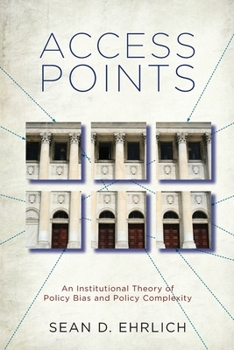
Access Points: An Institutional Theory of Policy Bias and Policy Complexity
No Customer Reviews

Access Points develops a new theory about how democratic institutions influence policy outcomes. Access Point Theory argues that the more points of access that institutions provide to interest groups, the cheaper lobbying will be, and, thus, the more lobbying will occur. This will lead to more complex policy, as policymakers insert specific provisions to benefit special interests, and, if one side of the debate has a lobbying advantage, to more biased policy, as the advantaged side is able to better take advantage of the cheaper lobbying. This book then uses Access Point Theory to explain why some countries have more protectionist and more complex trade policies than other; why some countries have stronger environmental and banking regulations than others; and why some countries have more complicated tax codes than others. In policy area after policy area, this book finds that more access points lead to more biased and more complex policy. Access Points provides scholars with a powerful tool to explain how political institutions matter and why countries implement the policies they do.
Format:Paperback
Language:English
ISBN:0199737541
ISBN13:9780199737543
Release Date:September 2011
Publisher:Oxford University Press
Length:208 Pages
Weight:0.65 lbs.
Dimensions:0.6" x 6.1" x 9.2"
Customer Reviews
0 rating
Copyright © 2026 Thriftbooks.com Terms of Use
| Privacy Policy | Do Not
Sell/Share My Personal Information | Cookie Policy | Cookie Preferences | Accessibility Statement
ThriftBooks® and the ThriftBooks® logo are registered trademarks of Thrift Books Global, LLC
ThriftBooks® and the ThriftBooks® logo are registered trademarks of Thrift Books Global, LLC
