


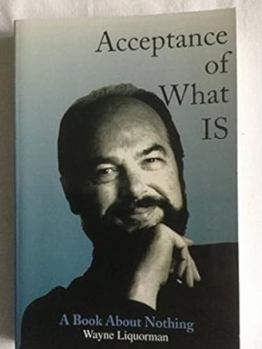
Acceptance of What Is: A Book About Nothing

Select Format
Select Condition 
Book Overview
A new look at Advaita through the eyes of the most unlikely of Sages - Wayne Liquorman. Wayne is a former alcoholic and drug addict who shortly after being 'struck sober' began a spiritual quest that... This description may be from another edition of this product.
Format:Paperback
Language:English
ISBN:0929448197
ISBN13:9780929448190
Release Date:March 2000
Publisher:Advaita Press
Length:298 Pages
Weight:0.92 lbs.
Customer Reviews
5 ratings
Essential
Published by Thriftbooks.com User , 16 years ago
This book made a deep impression on me. It is exceptionally entertaining and those who aren't threatened by Wayne's honesty, lack of cliche guru posturing, and wild sense of humour peppered with obscenity- very refreshing in the "spiritual world"- will feel the warmth shining through. It also contains some wonderful poems and quotes, old and contemporary, including some work by my musical hero Leonard Cohen. We all have different tastes, of course, and things can be approapriate at different times, but I found this book to be both enlightening and entertaining. I wish the chap who put his copy in the recycling had passed it on. What a waste. But.. Nothing out of place!!
easy style, to the point, requires no previous background
Published by Thriftbooks.com User , 22 years ago
This is a pretty useful book by considering the fact that it tries to bring home the same Advaita Vedanta message of `No Individual Doer', which is explained, in the Upanishads and the Bhagavad-Gita. Personal accounts of Wayne present the suddenness and nature of enlightenment and remove misconceptions surrounding Enlightenment, which lead a seeker into wrong and circuitous paths. This is the path of J~nana without expounding all the explanations and metaphysics of the Upanishadic teachings. It harps on only one principle "No Individual Doership". While Ramana Maharshi asks us to enquire Who is this `i/me', Ramesh Balsekar/Wayne ask us to enquire `Who is this Doer'. That is the only difference. The book is fairly well organized in terms of chapters on The Beginning of Seeking, The Sense of Personal Doership, Paths, Enlightenment, Guru and Disciple. The quotes between the chapters are interesting and refreshing. In my readings on the Advaita Philosophy, I found a lot of confusing books, which do not explain the `human-ness' of the `manifest multiplicity of the ONE'. Only Upanishads talk unambiguously of `All This IS Brahman', which obviously includes this `World', which in turn comprises Egos (Individuals or Individual selves, in our present normal ordinary man's awareness). I found that most books do not even come close to defining this `EGO' precisely. `Acceptance of What Is' does a good job in harmonizing this concept. On this topic this book goes a step further than Ramesh Balsekar's writings, in clarity.Page: 211 and 212"Okay, You see, I make a very precise distinction between the sense of personal doership and ego. And I do that for a specific reason. When the sense of personal doership disappears - the sense that I am the doer - there is still, within the body-mind mechanism, a structure which we would call the ego structure. The ego structure is that which knows it is Ramana Maharshi, such that when somebody calls out, "Ramana!" Ramana turns around. Without that ego structure there, Ramana doesn't know himself from Arunachala! (loud laughter) Because it is all Consciousness. Right? So, the sense of personal doership has disappeared. There is no longer any sense that I am doing anything. But, there is certainly a sense of presence as the body-mind mechanism that is associated, identified, as part of the body-mind mechanism. It is absolutely essential that it be there for functioning to happen. And you can say that this ego is the person-ality, where the person is associated with that body-mind mechanism. And that doesn't go. If it did, that body-mind mechanism wouldn't know what it ate, wouldn't have any memory, any culture. No learning, Nothing ! So, what goes is the sense of personal doership - not the ego structure." Page: 234"There's no intellectualization involved in the sage's present moment. Every aspect of the dream is real within the context of the dream. It is immediate, it is now, and it is an expression of One Consciousness. So
The title describes it perfectly
Published by Thriftbooks.com User , 23 years ago
this is as non-dual as it gets, folks.As to the reviewer who asked why his photo is on the cover, many seekers fall in love with a guru through a photo. The connection is that vibrant. in case that reviewer hasn't noticed, Ramana's photo is thrown around like candy. And check out the bookstore - Ramana's pictures ARE on his books. but that reviewer raises a good point, indirectly. The non-dual teaching is not for everyone. If you are reading other folks like U.G. Krishnamurthi and the like, and like them, Wayne, and this book, are fantastic. If you are looking for a pious guru who will give you prescriptions and say that your true nature is far away and difficult to reach, and that you must do a great deal of work before you reach the phantasmagoric state of enlightenment, don't waste your money on this book.
Wonderful Wayne
Published by Thriftbooks.com User , 23 years ago
If you are already interested in the Advaita philosophy and somewhat familiar with it, this book is in the "must read" category. I had attended some of Wayne's talks and read some books by Ramesh Balsekar, Wayne's teacher, before buying this book. I am captivated by it. I've read about half of it so far, slowly, joyfully, savoring each idea and the cheerfulness with which Wayne presents it. At first I thought Wayne was irreverent and harsh, but I no longer feel that way. If you are new to this philosophy, this may also be a good book, but Wayne recommended Ramesh Balsekar's "Consciousness Speaks" as an introductory book, and that was a good choice for me. But this book may also work well for a newcomer. It's hard for me to judge that because this philosophy, as simple as it is, is a bit slippery. Just when I think I'm getting it, it tends to slip away. But I am hooked on it, and this book is probably the most accessible discussion of it yet. Highly recommended!!
A Great Book !
Published by Thriftbooks.com User , 24 years ago
This is a great book, and it gets better with time. Its great appeal (and no doubt its main repulsiveness to some) will be that it totally deflates and tosses out the ego-balloon idea that "we are busy performing the right kind of actions that assist our own evolution". But there's more than that here, or as Wayne said, there's even less. This book adressed the same question Advaita always asks: what remains when all of your favorite beliefs and concepts are deflated and then left by the roadside ? One of the essential ideas from Advaita and Zen that is injested and then gradually understood is the idea of absolute non-doing. Having soaked in this idea from other writers such as Ramesh Balsekar, Satyam Nadeen, Wei Wu Wei, Tony Packer, and numerous others in the timeless stream of the expression that "consciousness is all there is", I really appreciate Wayne's book because of his humorous and insightful discussion of the many nuances surrounding the belief in personal doing-ship, as shown by the lengthy dialogues with his visitors, many of whom are precariously suspended over the void, holding onto a few remaining threads of belief in their own ideas concerning choice, control, decision-making, etc. The exchanges are very enjoyable to read ! This writing may appeal more to American and European readers, i.e., to 'westerners'. In this way, it feels to me that this book can be seen as 'the other bookend' to Ramesh's writings; its a "western" bookend. In this analogy, Zen and Advaita readers will know what's in between these two bookends.
Copyright © 2026 Thriftbooks.com Terms of Use
| Privacy Policy | Do Not
Sell/Share My Personal Information | Cookie Policy | Cookie Preferences | Accessibility Statement
ThriftBooks® and the ThriftBooks® logo are registered trademarks of Thrift Books Global, LLC
ThriftBooks® and the ThriftBooks® logo are registered trademarks of Thrift Books Global, LLC
