
Skip to content
Scan a barcode
Scan
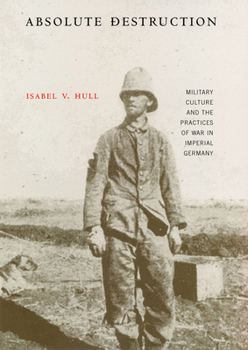
Paperback Absolute Destruction: Military Culture and the Practices of War in Imperial Germany Book

ISBN: B008VRS6JQ

ISBN13: 9780801472930

Absolute Destruction: Military Culture and the Practices of War in Imperial Germany

Select Format

Select Condition ThriftBooks Help Icon

Recommended

Format: Paperback

Condition: New

$23.03
Save $6.92!
List Price $29.95
Ships within 24 hours
Save to List

Book Overview

In a book that is at once a major contribution to modern European history and a cautionary tale for today, Isabel V. Hull argues that the routines and practices of the Imperial German Army, unchecked by effective civilian institutions, increasingly sought the absolute destruction of its enemies as the only guarantee of the nation's security. So deeply embedded were the assumptions and procedures of this distinctively German military culture that the Army, in its drive to annihilate the enemy military, did not shrink from the utter destruction of civilian property and lives. Carried to its extreme, the logic of "military necessity" found real security only in extremities of destruction, in the "silence of the graveyard."Hull begins with a dramatic account, based on fresh archival work, of the German Army's slide from administrative murder to genocide in German Southwest Africa (1904-7). The author then moves back to 1870 and the war that inaugurated the Imperial era in German history, and analyzes the genesis and nature of this specifically German military culture and its operations in colonial warfare. In the First World War the routines perfected in the colonies were visited upon European populations. Hull focuses on one set of cases (Belgium and northern France) in which the transition to total destruction was checked (if barely) and on another (Armenia) in which "military necessity" caused Germany to accept its ally's genocidal policies even after these became militarily counterproductive. She then turns to the Endkampf (1918), the German General Staff's plan to achieve victory in the Great War even if the homeland were destroyed in the process--a seemingly insane campaign that completes the logic of this deeply institutionalized set of military routines and practices. Hull concludes by speculating on the role of this distinctive military culture in National Socialism's military and racial policies.Absolute Destruction has serious implications for the nature of warmaking in any modern power. At its heart is a warning about the blindness of bureaucratic routines, especially when those bureaucracies command the instruments of mass death.

Customer Reviews

3 ratings

Flawed but Useful Study

Hull writes a flawed, but interesting, study about the relationship between the ideological underpinnings of the Imperial Germany Army and Germany's military failures since the Franco-Prussian War. Hull main point is that the Prussian (and then Imperial German Army's, Gr. Reichswehr's) overwhelming bias toward operational effectiveness both created, and was created by, a view of warfare so dedicated to the dstruction of enemy forces that it was blind to the political and strategic dimensions of war. As a result, Hull claims, German logistics were problematical, German Military Occupation was disastrous, German strategy was neglected, and German policy was virtually non-existent. Put more broadly, she believes that the German Army was so focused on winning battles and campaigns that it did not have the foggiest idea of how to win (or emerge favorably from) a larger war. Hull also aims at some bigger points, which she only touches on indirectly. First, her analysis would imply that Germany's conduct of World War II was largely a continuation and (great) amplification of its conduct in World War I and in Africa. Many prominent Nazis -- Hitler, Roehm, and many others come to mind -- were front line soldiers in World War I and had absorbed that military culture. Second, and related, the Imperial German State in general had so completely absorbed and deified that military culture that the German government shared the same failings as the German military. There is much in what Hull says. But there are also several significant faults in her analysis. First, she dislikes the German Army, despite attempts to remain objective, and thus sometimes makes it look less effective than it was. For example, she claims that German and French losses at Verdun were about equal, something few others would support. Second, she is sometimes ambivalent, if not contradictory. For example, she condemns the German High Command for failing to acknowledge when it was beaten, as for example when the United States entered the war. Yet she condemns its 1918 offensive strategy as reckless gambling, claiming that Germany could have held out far longer if it had adopted a more defensive strategy. Now Hull is probably right -- once the United States entered the war, Germany was probably doomed. But if this is true, Ludendorff and Hindenburg would seem to have done Germany a favor by ending the agony in one year rather than three or four through their adoption of an all-or-nothing strategy. Actually, Germany came fairly close to a favorable result in World War I, even if it could not have "won" outright. If it had continued to negotiate in good faith, eschued unrestricted submarine warfare, and maintained a relatively defensive posture in the West, Russia would have collapsed and there would have been a real chance at an acceptable peace. Of course, as Hull's own analysis suggests (it would have been helpful if she had been more explicit here, but her fixation

Perhaps total annihilation would be a good title for this book?

In this fascinating look at military culture in Imperial Germany, Isabel Hull has broken down the topic into three major categories: the development of the military culture, the definition of military culture in Germany, and how the military culture played out in the Great War during the period 1914-1918. In her opening section, Hull explains how the colonial wars of the early 20th century, where the Germans were attempting to suppress internal rebellions, became the precursor of an organizational culture that moved beyond suppression and into utilizing the mindset of total annihilation. Hull has largely examined the Herero (in Southwest Africa) as her case study, and the commanders of the German forces dispatched to quell the uprising. By examining military manuals and private papers of the military leadership, Hull demonstrates, quite convincingly, that the development of this strategy of utter destruction began during these wars. Hull then proceeds to explain how the military culture fit into the German military - almost like any organizational culture would pervade into a company. Further examination of diaries, letters, and other military papers explain how this strategy became the widely accepted tactic of German warfare. She explains how this concept differed from that of Britain's use of force to suppress rebels during the Boer War in an effort to explain that the pervasiveness of this thought process really only permeated the German psyche and not other European nations. Finally, the author explores how this strategy played out during the First World War (the "Great War"). By evaluating everything from the execution of the Schlieffen plan to the use of civilians as hostages, Hull offers the reader a carefully constructed argument that this war was fought using the tactics developed over the last several decades, though that led to Germany's defeat since the German commanders were unable to accept losses in battles and simply pushed on instead. Overall, this is a very well written book, and one that is a good addition to the historiography of the Great War; we can now better understand why the German troops acted as they did on the battlefield, and how this war paved the way for the National Socialist ideology that would creep into German society and cause another, greater, war only two decades later.

Robert Kaplan needs to read this book

Robert Kaplan in his book "Imperial Grunts," wants the military to assume a greater role in decision making and have no constraints imposed by civilians. Isabel Hull exposes the flaw of this approach in her book. Accroding to Hull, German soldiers committed numoerous atrocities from the Herro uprising to the First World War due to belief in absolute victory and the absence of civilian supervision. This was seen in the destruction of the Herro tribe in which the Germans delibrately starved the tribe to death, and the complaints by the civilian governors were ignored by the German government. The German government imposed no controls on the military because the conservative political parties supported the army and the SPD did not want to appear as though they were not supporting the troops. The German army continued these same practices during the First World War through the massacre of Belgian civilians, and the expulsion of French civilians. Also the German army encouraged the Turks in their genocide against the Armenians. These measures only tarnished Germany's reputation and were militarily counterproductive. I would strongly reccomend this book to people like Robert Kaplan, who wants the military to run wild in foreign adventures.
Copyright © 2026 Thriftbooks.com Terms of Use | Privacy Policy | Do Not Sell/Share My Personal Information | Cookie Policy | Cookie Preferences | Accessibility Statement
ThriftBooks® and the ThriftBooks® logo are registered trademarks of Thrift Books Global, LLC

GoDaddy Verified and Secured