


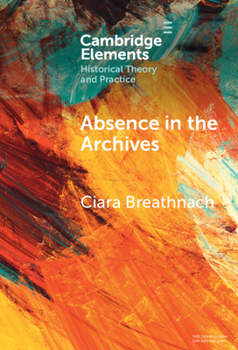
Absence in the Archives
No Customer Reviews

Absence in official records can have profound implications for social memory, civil rights, restorative and transitional justice, citizenship, social welfare, and redress for historical abuse. Scholars of archivistics and early modern New World imperial contexts have uncovered the epistemological problems that archival silences pose for historical research, and the author contends that absence deserves separate conceptual treatment. Archival absences, both permanent and temporary, have particular resonances for postcolonial countries, and are an ongoing threat under totalitarian regimes. Using Britain and Ireland as primary examples, this Element traces how absence took root in the domestic and subsequently the colonial archive, and how through legal mechanisms it became an accepted part of archival praxis. The aim of this Element is to raise awareness of archival absence in order to prevent more losses, particularly in the abundance of the digital age. This title is also available as Open Access on Cambridge Core.
Format:Hardcover
Language:English
ISBN:1009580086
ISBN13:9781009580083
Release Date:July 2026
Publisher:Cambridge University Press
Length:75 Pages
Related Subjects
HistoryCustomer Reviews
0 rating
Copyright © 2026 Thriftbooks.com
Terms of Use | Privacy Policy | Do Not Sell/Share My Personal Information | Cookie Policy | Cookie Preferences | Accessibility Statement
ThriftBooks ® and the ThriftBooks ® logo are registered trademarks of Thrift Books Global, LLC
ThriftBooks ® and the ThriftBooks ® logo are registered trademarks of Thrift Books Global, LLC
