


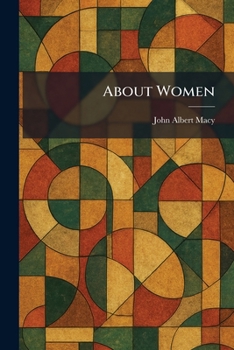
About Women

Select Format
Select Condition 
Book Overview
"About Women" is a sophisticated and thought-provoking collection of essays that examines the social, psychological, and intellectual standing of women in the early decades of the 20th century. John Albert Macy, a distinguished literary critic, provides a wide-ranging analysis of gender dynamics, exploring the shifting boundaries of femininity and the evolving expectations placed upon women in both public and private life. The work navigates complex themes such as the domestic sphere, education, economic independence, and the creative spirit, offering a candid look at the "woman question" from a period of significant social upheaval.
Macy's prose combines sharp observation with a deep appreciation for the historical and cultural forces that shape identity. As a cultural artifact, "About Women" offers invaluable insight into the historical discourse surrounding gender equality and the societal roles of men and women. It remains a compelling read for those interested in the history of feminism, social philosophy, and the development of gender studies. This collection captures a pivotal moment in social history, reflecting the tensions and aspirations of a world transitioning into modernity through a series of engaging and intellectual reflections.
This work has been selected by scholars as being culturally important, and is part of the knowledge base of civilization as we know it. This work was reproduced from the original artifact, and remains as true to the original work as possible. Therefore, you may see the original copyright references, library stamps (as most of these works have been housed in our most important libraries around the world), and other notations in the work.
This work is in the public domain in the United States of America, and possibly other nations. Within the United States, you may freely copy and distribute this work, as no entity (individual or corporate) has a copyright on the body of the work.
As a reproduction of a historical artifact, this work may contain missing or blurred pages, poor pictures, errant marks, etc. Scholars believe, and we concur, that this work is important enough to be preserved, reproduced, and made generally available to the public. We appreciate your support of the preservation process, and thank you for being an important part of keeping this knowledge alive and relevant.
Customer Reviews
ThriftBooks® and the ThriftBooks® logo are registered trademarks of Thrift Books Global, LLC
