


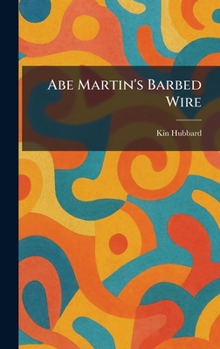
Abe Martin's Barbed Wire

"Abe Martin's Barbed Wire" is a clever and enduring collection of wit and wisdom from one of America's most celebrated humorists, Kin Hubbard. Centered on the iconic character of Abe Martin, a rural philosopher from Brown County, Indiana, this work captures the essence of early 20th-century American life through sharp satire and pithy aphorisms.
Hubbard's creation, Abe Martin, became a national cultural staple for his "cracker-barrel" philosophy, offering insightful and often biting commentary on politics, social customs, and the universal quirks of human nature. The book is structured as a series of brief, punchy observations-the namesake "barbed wire"-that snag the reader's attention with their blend of cynicism and truth. These sayings reflect the agrarian sensibilities and common-sense skepticism that defined a generation of Midwestern humorists.
As a significant contribution to American literary history, "Abe Martin's Barbed Wire" remains a testament to the power of short-form satire. Readers will find a treasure trove of humorous reflections that continue to resonate today, highlighting themes of vanity, hypocrisy, and the simple joys of rural existence. This collection is an essential read for fans of American folk humor and those seeking to experience the unique, sharp-edged voice of Kin Hubbard.
This work has been selected by scholars as being culturally important, and is part of the knowledge base of civilization as we know it. This work was reproduced from the original artifact, and remains as true to the original work as possible. Therefore, you may see the original copyright references, library stamps (as most of these works have been housed in our most important libraries around the world), and other notations in the work.
This work is in the public domain in the United States of America, and possibly other nations. Within the United States, you may freely copy and distribute this work, as no entity (individual or corporate) has a copyright on the body of the work.
As a reproduction of a historical artifact, this work may contain missing or blurred pages, poor pictures, errant marks, etc. Scholars believe, and we concur, that this work is important enough to be preserved, reproduced, and made generally available to the public. We appreciate your support of the preservation process, and thank you for being an important part of keeping this knowledge alive and relevant.
Customer Reviews
ThriftBooks® and the ThriftBooks® logo are registered trademarks of Thrift Books Global, LLC
