


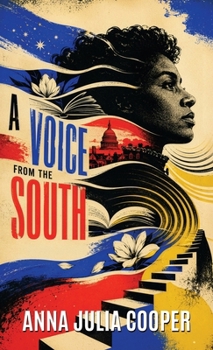
A Voice from the South: Equality Cannot Wait: Race, Gender, and the Work of Justice

In 1892, Anna Julia Cooper published one of the foundational works of Black feminist thought in the United States. Writing as an educator, scholar, Christian intellectual, and Black woman of the post-Reconstruction era, she confronts a nation that discusses race while marginalizing women and discusses womanhood while ignoring Black experience. Her central claim is both moral and practical: no community can rise while the abilities, education, and voices of its women are suppressed.
A Voice from the South gathers essays and addresses rather than presenting a single continuous argument. Cooper examines higher education, the responsibilities of teachers, racial prejudice, gender expectations, literary representation, moral leadership, and the failures of reform movements that treat justice as divisible. She challenges paternalism both within and beyond Black communities and insists that those most affected by oppression must be heard as thinkers, agents, and authorities.
Cooper's prose is learned, allusive, and rhetorically forceful. Drawing on history, scripture, literature, philosophy, and lived observation, she works within some nineteenth-century conventions even as she presses beyond their limits. Her arguments reveal how deeply questions of race, gender, education, and power are connected-and why no honest pursuit of equality can address them in isolation.
First published under the fuller title A Voice from the South: By a Black Woman of the South, the book made authorship itself part of its intervention. Cooper speaks from a position routinely excluded from national debate and transforms that exclusion into intellectual authority. These essays remain essential not because every formulation belongs to the present, but because their central demand still resonates: democracy must be judged by whose knowledge it recognizes, whose development it supports, and whose voice it permits to shape the future.
Customer Reviews
ThriftBooks ® and the ThriftBooks ® logo are registered trademarks of Thrift Books Global, LLC
