


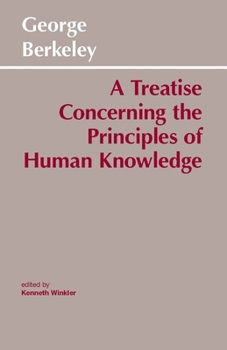
A Treatise Concerning the Principles of Human Knowledge (Hackett Classics)


Select Format
Select Condition 
Book Overview
George Berkeley's A Treatise Concerning the Principles of Human Knowledge is a seminal eighteenth-century philosophical work that explores the limits of human understanding. Berkeley, a leading figure... This description may be from another edition of this product.
Format:Paperback
Language:English
ISBN:0915145391
ISBN13:9780915145393
Release Date:December 1982
Publisher:Hackett Publishing Company, Inc.
Length:144 Pages
Weight:0.68 lbs.
Dimensions:8.8" x 0.5" x 5.8"
Customer Reviews
3 ratings
A must read for Philosophy Scholars
Published by Thriftbooks.com User , 20 years ago
A Treatise Concerning the Principles of Human Knowledge (Commonly called "Treatise" when referring to Berkeley's works) is a 1710 work by the Irish Empiricist philosopher George Berkeley. This book largely seeks to refute the claims made by his contemporary John Locke about the nature of human perception. Whilst, like all the Empiricist philosophers, both Locke and Berkeley agreed that there was an outside world, and it was this world which caused the ideas one has within one's mind; Berkeley sought to prove that outside world was also composed solely of ideas. Berkeley did this by suggesting that "Ideas can only resemble Ideas" - the mental ideas that we possessed could only resemble other ideas (not physical objects) and thus the external world consisted not of physical form, but rather ideas. This world was given logic and regularity by some other force, which Berkeley did his best to conclude was a God. Long refuted by most philosophers, Berkeley's claims are often felt to have been a form of rationalisation - Berkeley later became Bishop of Cloyne, and was a highly religious man. Treastise's suggestion that the world was made of ideas with an omnipitent force guiding was his alternative to the Lockean Empiricism popular at the time, which Berkeley felt led to skepticism. In spite of this Berkeley was a capable, respected and entertaining thinker. Some doubt exists as to whether he truly believed his conclusion that the world at large was composed of ideas; with modern thinking tending towards him indeed having thought this to be the case.
Ideal Idealism
Published by Thriftbooks.com User , 24 years ago
This is not the place for a philosophical analysis of Berkeley's original text, and its content of argument. The review concerns the specific book edited by Dancy, and its worth in respect of its further contribution to understanding the Treatise.This book is to be strongly recommended as it provides a multitude of resources that contextualise, criticise, and clarify, the positions put forward by Berkeley in this work. The most substantial contribution is the extensive introduction comprised of 15 punchy sections, covering Berkeley's life, his academic heritage, and analysis of his thought (both internal and external to that given in the Treatise). Dancy is fair to Berkeley in setting forth the most robust defences of his position, and marshalling critical arguments against the Berkelian stance. This is supplemented by an extremely thorough set of endnotes that are continually present in the background of the text, offering detailed guidance whenever necessary, or desired.Additionally, the book offers a summarised concise overview of the arguments provided in the Treatise, a glossary of archaic terms(!), and a very helpful short section entitled "How to use this book" (why don't more books include this sort of thing?). There is also a manageable annotated bibliography of further reading to trail a path for academic expansion.Overall, I found that this book provided a systematic treatment of the text and provided a solid structure of support surrounding the subject. Also included, the letters between Berkeley and Johnson, provide an unexpected bonus. This book is relatively cheap, considering its breadth and depth. In my opinion, it is an ideal text through which to study (and enjoy) Berkeley's Treatise.
an interesting reading
Published by Thriftbooks.com User , 26 years ago
This is a very important work of George Berkeley. On of its most interesting topics is that about the existence of matter. As, for human beings, the "existence" of something is related to its perception, there is a very close link between "things" and ideas. Both cannot have their existence completely proved. The arguments place the book among the most interesting on the top issues discussed in its time (empiricism, materialism, etc.)
Copyright © 2026 Thriftbooks.com
Terms of Use | Privacy Policy | Do Not Sell/Share My Personal Information | Cookie Notice | Cookie Preferences | Accessibility Statement
ThriftBooks ® and the ThriftBooks ® logo are registered trademarks of Thrift Books Global, LLC
ThriftBooks ® and the ThriftBooks ® logo are registered trademarks of Thrift Books Global, LLC
