


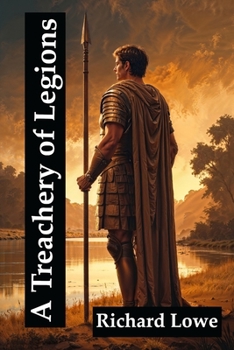
A Treachery of Legions

Rome, 69 AD. Four men will claim the throne before the year is out. Three of them will die for it.
Marcus Antonius Primus has spent twenty years earning everything Rome can give a man who started with nothing - a tenant farmer's son from Toulouse who enlisted at thirteen, picked up a dying centurion's vine staff in a river battle at sixteen, and built a military career through competence and the careful management of the right kind of attention. Now he commands a legion on the Danube frontier, watching the empire tear itself apart from a safe distance.
He does not stay at a safe distance.
What follows is the story of a man who reads situations correctly and uses the reading for himself - who feeds intelligence to the wrong side of a civil war, marches without orders, wins a battle that makes an emperor, and cannot hold his men in the city afterward. He carries Cremona and the betrayal for the rest of his life, without excuse and without resolution, the way men carry the permanent things.
Alongside him: Julia, his wife, who has been running a twenty-year political operation in Rome while he fights his wars, and who knows things he doesn't know she knows. Brunhild, a Quadi chieftain's daughter across the Danube, who reads Roman formations because Romans killed her kin and who meets Primus at a riverbank parley with intelligence he has no reason to trust and acts on immediately. And Vespasian - the compact, unremarkable man who ends the novel with a sword at Primus's throat, asking a question he already knows the answer to.
A Treachery of Legions is a novel about authority and its cost, about the distance between the man you say you are and the man you have been, and about the specific quality of a frontier river at dawn when you are the only person awake and the work is what there is.
Narrated by Primus himself at sixty-three, looking back at everything with the clarity and the selective blindness of a man who has had decades to decide what version of events he can live with, this is historical fiction that refuses to make the past comfortable - that insists the Romans were not performing modernity in togas, that guilt was a different thing for them, that the gods were present and operational, and that the distance between their world and ours is real and worth inhabiting.
Based on the documented historical figure of Marcus Antonius Primus, general of the Flavian cause in the Year of the Four Emperors. The interior life, the marriage, the woman across the river, and the sword scene are invented. The war, the battles, the sack of Cremona, and the burning of the Capitoline are not.
Customer Reviews
ThriftBooks ® and the ThriftBooks ® logo are registered trademarks of Thrift Books Global, LLC
