


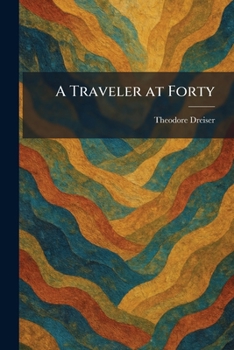
A Traveler at Forty

"A Traveler at Forty" is a compelling and deeply personal travel memoir by the renowned American novelist Theodore Dreiser. Marking his first journey to Europe, this work offers a fascinating departure from Dreiser's usual naturalistic fiction, providing instead a vivid account of his observations, encounters, and internal reflections while traversing the European continent at a pivotal moment in his life and career.
The narrative follows Dreiser as he explores major cultural hubs, including London, Paris, and various cities throughout Italy and Germany. Rather than a mere recitation of tourist landmarks, the work delves into the social structures, local customs, and the human condition as viewed through Dreiser's keen, often skeptical eye. His descriptions are characterized by a raw honesty and a focus on the gritty realities of early 20th-century life, contrasting the grandeur of the Old World with the sensibilities of a quintessentially American writer.
As a significant piece of literary travel writing, "A Traveler at Forty" serves as both a historical document of Europe before the Great War and a profound self-portrait of an artist seeking to understand his place in the world. Dreiser's prose captures the excitement and disillusionment of travel, making it a valuable read for those interested in his literary development and the history of transatlantic cultural exchange.
This work has been selected by scholars as being culturally important, and is part of the knowledge base of civilization as we know it. This work was reproduced from the original artifact, and remains as true to the original work as possible. Therefore, you may see the original copyright references, library stamps (as most of these works have been housed in our most important libraries around the world), and other notations in the work.
This work is in the public domain in the United States of America, and possibly other nations. Within the United States, you may freely copy and distribute this work, as no entity (individual or corporate) has a copyright on the body of the work.
As a reproduction of a historical artifact, this work may contain missing or blurred pages, poor pictures, errant marks, etc. Scholars believe, and we concur, that this work is important enough to be preserved, reproduced, and made generally available to the public. We appreciate your support of the preservation process, and thank you for being an important part of keeping this knowledge alive and relevant.
Customer Reviews
ThriftBooks ® and the ThriftBooks ® logo are registered trademarks of Thrift Books Global, LLC
