


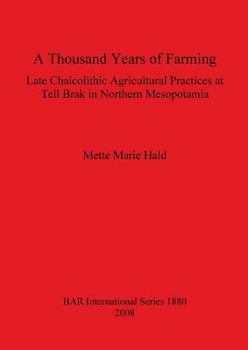
A Thousand Years of Farming: Late Chalcolithic Agricultural Practices at Tell Brak in Northern Mesopotamia
No Customer Reviews

The Late Chalcolithic is a period of far-reaching changes in many aspects of life in Mesopotamia. On the southern alluvial plain (present day Iraq) the first city states appear, among them the city of Uruk, which grows to become the largest of the citiesin the south. The growth of cities coincides with evidence for elaborate ritual building complexes, an increasingly class-stratified society, industrial specialisation, and multi-tiered administration, which includes the invention of writing. The present volume focuses on the agricultural developments in Late Chalcolithic northern Mesopotamia from the perspective of a major settlement in the region, Tell Brak in modern northeast Syria. Agriculture formed the basis of the economy of ancient Near Eastern communities; a study of the crop husbandry practices of Tell Brak can potentially identify the plant economy of the site, including the crops present in the settlement, and methods of crop processsing and use. Any agricultural responses to changes in the socio-political system, known from the archaeological evidence to have taken place during the Late Chalcolithic, can also be assessed. These responses may be able to give us an indication of the wider economic responses to societal change during the Late Chalcolithic.
Format:Paperback
Language:English
ISBN:1407303600
ISBN13:9781407303604
Release Date:December 2008
Publisher:British Archaeological Reports Oxford Ltd
Length:190 Pages
Weight:1.38 lbs.
Dimensions:0.5" x 8.3" x 11.7"
Customer Reviews
0 rating
Copyright © 2026 Thriftbooks.com Terms of Use
| Privacy Policy | Do Not
Sell/Share My Personal Information | Cookie Policy | Cookie Preferences | Accessibility Statement
ThriftBooks® and the ThriftBooks® logo are registered trademarks of Thrift Books Global, LLC
ThriftBooks® and the ThriftBooks® logo are registered trademarks of Thrift Books Global, LLC
