


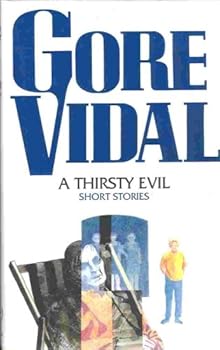
A Thirsty Evil

Select Format
Select Condition 
Book Overview
From the poignant realisation as an adult of the cruel brutality of childhood in 'The Robin', man then comes face to face with himself as a boy in 'A Moment of Green Laurel': both stories combining... This description may be from another edition of this product.
Format:Hardcover
Language:English
ISBN:0233988815
ISBN13:9780233988818
Release Date:January 1994
Publisher:ANDRE Deutsch Limited
Length:140 Pages
Weight:0.75 lbs.
Related Subjects
Contemporary Fiction Literature & Fiction Mystery Mystery, Thriller & Suspense Short StoriesCustomer Reviews
5 ratings
Vidal's only collection of stories, written during the years after "The City and the Pillar"
Published by Thriftbooks.com User , 17 years ago
These seven early stories (surprisingly, Vidal's only collection of short fiction) were originally written between 1948 and 1956 and were published in various relatively small but influential journals. They all post-date the publication of "The City and the Pillar," and it's clear that the controversy and notoriety of that novel allowed Vidal a bit of artistic latitude; three of them deal overtly with gay themes (and a fourth does so more subtly) and all seven have a dark, almost gothic tinge that sets off their post-Edwardian style. Each story has its own distinctive merits, but my favorite is the first: "Three Stratagems." In the then-closeted gay community of Key West, a newly arrived hustler quickly befriends a widower whose insecurity is undergirded by the unvoiced understanding that the older man desires companionship while the young man's needs are far more basic. But the tables are unexpectedly turned; the fickle pecking order is upended; there are "flaws" (such as unpleasant medical conditions) that trump youth, and the older gentleman casts his catch back into the turbulent seas of a coldhearted society. This story has an unforeseen resonance in the era of AIDS, which has altered and segregated the "scene" in disturbingly similar ways during the last two decades. "A Thirsty Evil" has recently been re-released with its originally proposed title, "Clouds and Eclipses," and with the addition of a story of the same name, based on a childhood memory related to Vidal by Tennessee Williams about an Episcopal priest. The story was omitted at the request of Williams, who was concerned his mother might recognize the lead character. These stories exhibit a precocious talent for a writer then in his twenties and they are worth revisiting not only for their own enjoyment but also to appreciate the promise Vidal displayed in a genre he inexplicably abandoned.
'...and when we drink, we die'.
Published by Thriftbooks.com User , 18 years ago
A Thirsty Evil is an excellent collection of short stories, both in terms of literary merit and sheer entertainment value. Gore Vidal tells brilliant tales in an extremely beguiling, deceptively simple style, that misses no important detail, and manages to suggest all kinds of hidden meanings the reader is allowed to unpack and interpret as he may. Three of the stories have homosexual themes. Brilliantly plotted (as are the rest of the stories), Three Stratagems has two narrators, one a young male prostitute plying his trade in Key West, and the other his elderly pick-up, George Royal. The contrasting view-points accentuate the pathetic sadness of both mens' lives. The climax - expertly prepared for - is superbly done. The final sentence is perfectly judged acidic irony. The Zenner Trophy is the story of an expulsion of a pair of male students caught doing something 'wrong'. More interesting as a character than Flynn, the gay student (a little too idealized), is the unfortunate Mr. Beckman, the teacher sent to give him his marching orders, who progresses during the course of the story from sycophancy towards the repulsive, reactionary Principal (an incisive demolition job by Vidal), to sympathy for Flynn, to hate 'for reminding him' that he is moving 'farther and farther from this briefly glimpsed design within a lilac day'. Pages From An Abandoned Journal is the story of the homosexual awakening of an American student in Paris, through his meetings with an 'infamous', opium-addicted, ex-male prostitute (retired at thirty-six) who began his career at the age of sixteen, and whose primary pleasure now is pursuing - and catching - fourteen-year-old boys. The contrast between the early, 'straight' part of the journal ('Hilda...is a good deal softer than she looks and it was like sinking into a feather mattress') and, after a few years of silence, his total transformation into as queer a queer as you could want, seems perfectly natural. The ending indicates how the more people change, the more they remain the same. Robin is a very short, but effective story of two boys learning about the reality of human viciousness. Erlinda And Mr. Coffin is the hilarious account of an amateur theatrical production that goes very, very wrong, narrated splendidly by 'a gentlewoman in middle life', in 'reduced' circumstances, who has to take in lodgers such as the unusual title characters. A Moment Of Green Laurel is one of the two masterpieces in the book, a beautifully-written, ambitious story. The climactic event - the meeting of an older man with, literally, his childhood self - is as inconclusive as his meeting, earlier, with various people, including his mother, during an Inauguration Day of a new President in Washington. As the story ends, one may conclude - taking the hints, such as the phrase 'definite schizoid tendency' - this is probably a case of solipsistic insanity. The powerful atmosphere and intimations of loss, however, go on ta
A Treasure-trove of Vidal Stories
Published by Thriftbooks.com User , 19 years ago
Many of us know Gore Vidal through his novels and essays so it was quite a find to get a copy of these seven short stories. He wrote them from 1948 to 1956-- the dates are given after each story-- and like his ground-breaking novel THE CITY AND THE PILLAR, published during the same period (1948), several of these stories are about controversial topics for that period and were well ahead of their time. Others show his comic gift as well as his insight into Washington politics. In "Three Stratagems" George Royal is an older man who picks up a young hunk in Key West who gives him both a false name (Michael) and life although he understands he shouldn't talk too much at first in order not to be found out. "I [the hunk] told him I'd played football at Princeton which was not true." What is most interesting about this story is the cat and mouse game that these two men engage in as their dinner date progresses. Whatever George has in mind for the evening's finale comes to a halt when the hunk has an epileptic seizure. In "The Robin" two nine-year-olds discover they are capable of extreme cruelty as they kill a wounded, helpless bird. "Erlinda and Mr. Coffin" is a terribly clever look at race and class with a surprise ending as good if not better than anything O'Henry ever wrote. In "Pages from an Abandoned Journal" Vidal traces the ten year journey of the narrator, who starts out as a somewhat innocent, somewhat straight man from Toledo studying in France and seeing a woman with whom he is having bad sex. In his May 22, 1948 journal entry he writes: "It wasn't very successful last night. Hilda kept talking all the time which slows me down, also she is a good deal softer than she looks and it was like sinking into a feather mattress." Of course he ultimately gets into alcohol, furniture and "attractive" men as we suspected he would from the beginning. My favorite story is "The Zenner Trophy," so modern that it could have been written in 2006. Days before commencement at a private, ritzy eastern high school, Sawyer and Flynn, two star athletes, have been caught in a "moral lapse" by two faculty members, have just been expelled and will not graduate. Flynn then won't be given the Zinner Trophy for outstanding athletic excellence. Beckman, Flynn's advisor and deep in the closet, has the unpleasant task of dealing with this tawdry situation since the rock-like principal is only interested in the "Grail-like quest for endowments." In a moving scene that is way ahead of Stonewall, the defiant Flynn tells Beckman that what he and Sawyer have done is nobody's business but theirs, "after all it doesn't affect anybody else." Then the reader learns that contrary to what everyone aware of the situation thinks-- that Sawyer has already left school in disgrace-- that he is waiting for Flynn at "the inn" and that the two of them will go to college together. These seven stories are very fine indeed and should appeal to Vidal fans as well as new readers as well.
Gore Vidal, our underrated man of letters
Published by Thriftbooks.com User , 23 years ago
It seems that Gore Vidal never quite gets the attention he deserves. His is one of the sharpest and freshest intellects around, and his writing is as good as one might expect from that description. It is only his essays, however, that seem to get much attention, but I contend that his novels, and this--his only collection of short stories--deserve, no, demand equal attention. Each story in here is well done and a pleasure to read; they are also stimulating to the mind. How often do I have the pleasure of saying I loved every short story in a single collection? It is a rare experience, I assure you. Highly recommended.
A Great Collection and My Introduction to Vidal
Published by Thriftbooks.com User , 25 years ago
This collection is very short, but very much a treat. It is the first work I read of Vidal's and I am very glad I ran into it (I saw it in Bargain Books at Barnes and Nobel, and such a low price on an author I'd been wanting to read was too tempting :-). The first story, "Three Stratagems," is a curious little gem about a hustler garnering the interest of a wealthy man. The atmosphere and narration are absorbing, and what happens at the end when the young hustler is in the rich man's room is truly surprising. "The Robin," is a short and disquieting piece about an old man looking back upon the cruelties of youth. "A Moment of Green Laurel" was definately interesting; as you read you strugle to figure out if the main character is crazy or the memories that haunt him do materialize in the way they do. At the end of the story, he finds himself face to face with himself as a young boy. "The Zenner Trophy" is a touching and aptly written piece. A boy is being evicted from his high school a mere couple weeks before graduation after being caught having never-specified homosexual relations with another student, but it is to be discovered that the closeted teacher sent to give him the news is taken it hard while the boy is seemingly indifferent; a great story on the commentary of the growing strength of each generation. "Erlinda and Mr Coffin," is not the books most entertaining piece, but it is decent anyway. It deals with the internal struggle of an old woman who fears what friens will think because she has a non-white girl staying in her boarding-house/hotel, as well as a dramatic fight between the girl--who has amazing voice-acting abilities--and the opporater of a local theatre. "Pages From An Abandoned Journal," is a fun, interesting story of the evolution of one man from being engaged to a woman, and the events that bring him to self realization. The story ends with him gay-clubbing and talking of his ex-lover, Bill. He meets some very interesting and entertaining characters on the way. The book ends with "The Ladies of the Library," which is a very intriguing piece reported to have many shades of Mann's A Death In Venice (I have not read the work yet, so I can not verify the similarities or their extent.)This is a great collection, and a gay classic from when homosexuality was still called "sexual inversion."
Copyright © 2026 Thriftbooks.com Terms of Use
| Privacy Policy | Do Not
Sell/Share My Personal Information | Cookie Policy | Cookie Preferences | Accessibility Statement
ThriftBooks® and the ThriftBooks® logo are registered trademarks of Thrift Books Global, LLC
ThriftBooks® and the ThriftBooks® logo are registered trademarks of Thrift Books Global, LLC
