


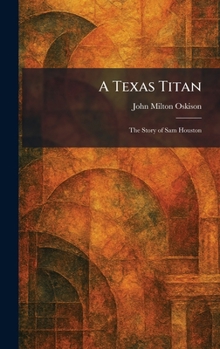
A Texas Titan: The Story of Sam Houston

"A Texas Titan" offers a compelling narrative exploration of the life and legacy of Sam Houston, one of the most towering and enigmatic figures in American history. Written by John M. Oskison, this biographical work traces Houston's extraordinary journey from his early days in Tennessee and his deep immersion in the culture of the Cherokee Nation to his pivotal role in the struggle for Texan independence.
The story captures the raw energy of the American frontier, depicting Houston not merely as a soldier and politician, but as a man of complex character and iron will. Readers follow his ascent as he leads the Texan forces at the Battle of San Jacinto, eventually rising to become the first President of the Republic of Texas. Oskison's prose brings to life the political intrigue, personal sacrifices, and grand ambitions that defined Houston's career.
Rich in historical detail and dramatic tension, "A Texas Titan" serves as both an intimate portrait of a leader and a sweeping chronicle of the birth of a state. It remains an essential read for those interested in the legends of the West, the evolution of the United States during the nineteenth century, and the enduring spirit of the man who helped shape the destiny of Texas.
This work has been selected by scholars as being culturally important, and is part of the knowledge base of civilization as we know it. This work was reproduced from the original artifact, and remains as true to the original work as possible. Therefore, you may see the original copyright references, library stamps (as most of these works have been housed in our most important libraries around the world), and other notations in the work.
This work is in the public domain in the United States of America, and possibly other nations. Within the United States, you may freely copy and distribute this work, as no entity (individual or corporate) has a copyright on the body of the work.
As a reproduction of a historical artifact, this work may contain missing or blurred pages, poor pictures, errant marks, etc. Scholars believe, and we concur, that this work is important enough to be preserved, reproduced, and made generally available to the public. We appreciate your support of the preservation process, and thank you for being an important part of keeping this knowledge alive and relevant.
Customer Reviews
ThriftBooks ® and the ThriftBooks ® logo are registered trademarks of Thrift Books Global, LLC
