


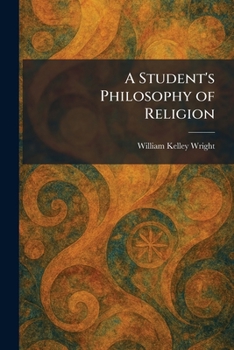
A Student's Philosophy of Religion

Select Format
Select Condition 
Book Overview
"A Student's Philosophy of Religion" offers a thorough and accessible introduction to the philosophical investigation of religious beliefs, practices, and traditions. Authored by William Kelley Wright, Ph.D., this scholarly work is designed to help readers navigate the complex intersection of faith, reason, and scientific inquiry.
The text begins by exploring the historical and psychological origins of religion, tracing its evolution from primitive forms to the sophisticated systems of the modern world. Wright delves into critical topics such as the validity of religious experience, the existence of God, the problem of evil, and the concept of immortality. By presenting a balanced overview of various philosophical schools of thought, the work encourages readers to develop their own reasoned perspectives on the ultimate questions of existence.
As a foundational text in the field, "A Student's Philosophy of Religion" remains a significant contribution to the academic study of theology and philosophy. It is particularly valued for its clear prose and its commitment to an objective, empirical approach to understanding the role of religion in human life and culture.
This work has been selected by scholars as being culturally important, and is part of the knowledge base of civilization as we know it. This work was reproduced from the original artifact, and remains as true to the original work as possible. Therefore, you may see the original copyright references, library stamps (as most of these works have been housed in our most important libraries around the world), and other notations in the work.
This work is in the public domain in the United States of America, and possibly other nations. Within the United States, you may freely copy and distribute this work, as no entity (individual or corporate) has a copyright on the body of the work.
As a reproduction of a historical artifact, this work may contain missing or blurred pages, poor pictures, errant marks, etc. Scholars believe, and we concur, that this work is important enough to be preserved, reproduced, and made generally available to the public. We appreciate your support of the preservation process, and thank you for being an important part of keeping this knowledge alive and relevant.
Customer Reviews
ThriftBooks ® and the ThriftBooks ® logo are registered trademarks of Thrift Books Global, LLC
