


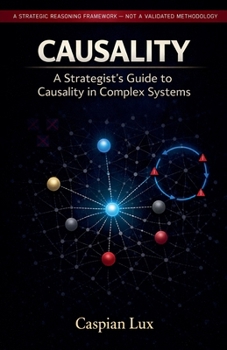
A Strategist's Guide to Causality in Complex Systems: Moving Beyond Planning to Adaptive Intervention

Strategic failure in complex systems is rarely a problem of execution. It is a problem of causal reasoning.
In environments characterized by nonlinearity, feedback, and emergence, traditional planning frameworks misidentify leverage and overestimate control. Decisions made on the basis of correlation, historical extrapolation, or simplified models often produce unintended and persistent effects.
A Strategist's Guide to Causality in Complex Systems presents a disciplined framework for reasoning about causation, intervention, and system behavior under uncertainty. Drawing on complexity science, causal inference, and network thinking, the book emphasizes model humility, empirical testing, and ethical restraint.
Written for advanced practitioners and scholars, it treats strategy as an epistemic practice rather than a predictive science.
This is not a methodology promising outcomes.
It is a framework for disciplined intervention when certainty is unavailable.
Customer Reviews
ThriftBooks® and the ThriftBooks® logo are registered trademarks of Thrift Books Global, LLC
