


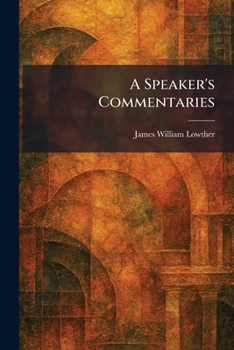
A Speaker's Commentaries

Select Format
Select Condition 
Book Overview
"A Speaker's Commentaries" offers a profound and firsthand account of the inner workings of the British Parliament during one of its most transformative eras. Penned by James William Lowther, who served with distinction as the Speaker of the House of Commons from 1905 to 1921, these memoirs provide an unparalleled perspective on the political landscape of the early 20th century. Lowther guides the reader through the intricacies of parliamentary procedure, the pressures of the First World War, and the shifting social dynamics of the Edwardian and Georgian periods.
The narrative is rich with personal anecdotes and professional insights, capturing the essence of the debates and personalities that shaped modern British history. From the constitutional crises of the era to the daily responsibilities of maintaining order in a boisterous chamber, the work serves as both a historical record and a masterclass in diplomacy and governance. Readers interested in political science, British history, and the evolution of democratic institutions will find Lowther's observations to be an essential resource. "A Speaker's Commentaries" remains a vital testament to a life dedicated to public service and the preservation of parliamentary tradition.
This work has been selected by scholars as being culturally important, and is part of the knowledge base of civilization as we know it. This work was reproduced from the original artifact, and remains as true to the original work as possible. Therefore, you may see the original copyright references, library stamps (as most of these works have been housed in our most important libraries around the world), and other notations in the work.
This work is in the public domain in the United States of America, and possibly other nations. Within the United States, you may freely copy and distribute this work, as no entity (individual or corporate) has a copyright on the body of the work.
As a reproduction of a historical artifact, this work may contain missing or blurred pages, poor pictures, errant marks, etc. Scholars believe, and we concur, that this work is important enough to be preserved, reproduced, and made generally available to the public. We appreciate your support of the preservation process, and thank you for being an important part of keeping this knowledge alive and relevant.
Customer Reviews
ThriftBooks ® and the ThriftBooks ® logo are registered trademarks of Thrift Books Global, LLC
