


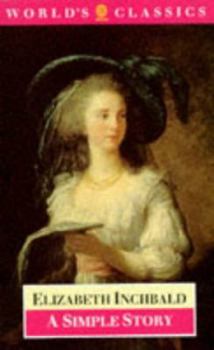
A Simple Story (The ^AWorld's Classics)


Select Format
Select Condition 
Book Overview
When Miss Milner announces her passion for her guardian, a Catholic priest, she breaks through the double barrier of his religious vocation and 18th-century British society's standards of proper womanly behavior. Like other women writers of her time, Elizabeth Inchbald concentrates on the question of a woman's "proper education," and her sureness of touch and subtlety of characterization prefigure Jane Austen's work.
Format:Paperback
Language:English
ISBN:019281849X
ISBN13:9780192818492
Release Date:December 1988
Publisher:Oxford University Press
Length:384 Pages
Weight:0.50 lbs.
Dimensions:7.3" x 0.7" x 4.6"
Customer Reviews
3 ratings
Worth reading (SPOILERS)
Published by Thriftbooks.com User , 19 years ago
A Simple Story could almost be read as two separate novels. The first tells the story of the beautiful young heiress, Miss Milner, who falls in love with her inflexibly principled guardian, Mr. Dorriforth (later Lord Elmwood). There are numerous bars to their union - the foremost being that he is a Catholic priest, who has taken a vow of celibacy, and that she is a coquette whose behaviour repeatedly offends his strict moral code. By the end of Volume II, all obstacles preventing their marriage have been removed, and we are led to assume they will live happily ever after. However, as Volume III opens - seventeen years later - we learn they have not lived happily ever after. Lady Elmwood (nee Milner) is now dying, a fallen woman, and Lord Elmwood has long since cast off both her and their daughter Matilda. Volumes III and IV tell the story of how the blameless Matilda tries to win back her implacable father's affection, and gains the heart of his nephew and heir, the lovable Mr. Rushbrook. Though the characters in A Simple Story sometimes behave in ways that, to my mind, strain credulity, it is well-written, and a more enjoyable read than many other novels written before Jane Austen came along.
Excellently written novel
Published by Thriftbooks.com User , 23 years ago
Inchbald has a great talent with words. This books is insightful, provocative and dramatic. Inchbald talks about love with such candidness and frankness that while your reading you can't help but feel an overflowing of emotions toward the main characters. Very satisfying ending the tidies up all the problems throughout the book.
A book of its time, fine characterization and insight
Published by Thriftbooks.com User , 27 years ago
This is no "Gone With the Wind" -- everybody gets what they deserve, according to the strictest moral code, and some get it with interest.However, Inchbald excels at characterization -- she unites vanity and passion in one character, and still has a believable personality to show the reader -- and she can show a character in change, without losing the character's integrity. Although the tragedy she creates has a moral "told you so" aspect hard for modern readers to take, it also has the pathetic grandeur of the great tragedies -- small, pointless faults and actions which lead to irreversible pain. The humanity of Inchbald's insight is what makes this book one of my favorites among the 18th century women writers.
Copyright © 2026 Thriftbooks.com Terms of Use
| Privacy Policy | Do Not
Sell/Share My Personal Information | Cookie Policy | Cookie Preferences | Accessibility Statement
ThriftBooks® and the ThriftBooks® logo are registered trademarks of Thrift Books Global, LLC
ThriftBooks® and the ThriftBooks® logo are registered trademarks of Thrift Books Global, LLC
