


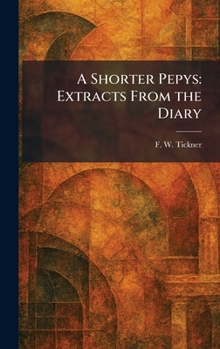
A Shorter Pepys: Extracts From the Diary

"A Shorter Pepys" presents a curated selection of extracts from the legendary diary of Samuel Pepys, offering a vivid and intimate window into the life and times of 17th-century London. Covering the tumultuous years between 1660 and 1669, this work captures the essence of one of the most famous journals in the English language, condensed for a focused reading experience.
The text provides firsthand accounts of era-defining events, including the Restoration of Charles II, the devastating Great Plague, and the Great Fire of London. As a high-ranking naval official, Pepys was uniquely positioned to document the political and military maneuvers of the Stuart court. However, it is his remarkably candid reflections on his personal life, domestic struggles, and social observations that have cemented the diary's status as a literary masterpiece.
This collection highlights the most significant historical and cultural passages, preserving the vitality and wit of Pepys's original prose. "A Shorter Pepys" serves as both an invaluable historical document and a deeply human portrait of a man navigating the complexities of public duty and private life during a period of monumental change.
This work has been selected by scholars as being culturally important, and is part of the knowledge base of civilization as we know it. This work was reproduced from the original artifact, and remains as true to the original work as possible. Therefore, you may see the original copyright references, library stamps (as most of these works have been housed in our most important libraries around the world), and other notations in the work.
This work is in the public domain in the United States of America, and possibly other nations. Within the United States, you may freely copy and distribute this work, as no entity (individual or corporate) has a copyright on the body of the work.
As a reproduction of a historical artifact, this work may contain missing or blurred pages, poor pictures, errant marks, etc. Scholars believe, and we concur, that this work is important enough to be preserved, reproduced, and made generally available to the public. We appreciate your support of the preservation process, and thank you for being an important part of keeping this knowledge alive and relevant.
Customer Reviews
ThriftBooks ® and the ThriftBooks ® logo are registered trademarks of Thrift Books Global, LLC
