


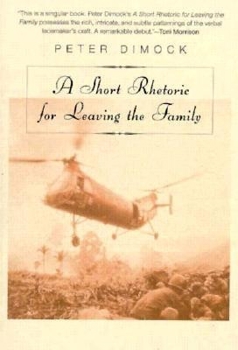
A Short Rhetoric for Leaving the Family

Select Format
Select Condition 
Book Overview
Hundreds of novels have explored the war in Vietnam. This is the first to explore the world of the architects of that war, and it cuts terribly close to home. Dimock brilliantly exposes the pained heart of a single family and offers a vision of what their way of life still costs us all. His book raises with startling freshness ancient yet urgent questions about relations between image, word, and act.
Format:Paperback
Language:English
ISBN:1564782107
ISBN13:9781564782106
Release Date:February 1990
Publisher:Dalkey Archive Press
Length:128 Pages
Weight:0.50 lbs.
Dimensions:0.4" x 5.4" x 8.0"
Grade Range:Postsecondary and higher
Related Subjects
Contemporary Domestic Life Fiction Genre Fiction Historical Literature & Fiction Women's FictionCustomer Reviews
3 ratings
A Truly Literary Novel
Published by Thriftbooks.com User , 21 years ago
Few contemporary novelists have the courage to use the use of language to tell a story. In "A Short Rhetoric," Peter Dimock does this, and does it both successfully and appropriately. It is difficult to express, not to mention convey, feelings about the Vietnam War, especially when your father was one of the principal people leading the U.S. into it. To convey his feelings, the narrator tries to use the rules of rhetoric to control and structure what he has to say, but his emotions still come pouring through. For readers looking for a completely new literary experience, this is a great novel. It is experimental in all the best ways, and unlike so many writers of experimental novels, Dimock (an editor himself) understands that less is more.
An Astonishing Book
Published by Thriftbooks.com User , 22 years ago
I continue to be shaken and humbled by each re-reading of this novel. The distortion of personal love by public events, the wrenching claims of family and country placed upon personal identity, the problem of remaining sane while being connected to madness, these are some of the themes addressed by this deeply gifted writer.I compare this novel, in my pantheon of favorite books, to "The Good Soldier." If the characters of that novel danced a minuet, then Peter Dimock's narrator dances a Sarabande--but according to the original form of that dance, increasing in its variations after a Dionysian plan. The Sarabande was once forbidden in an earlier century. "A Short Rhetoric for Leaving the Family" is, in my view, a requirement for anyone who tries to understand human beings in America in 2004.
Outstanding -- eludes any comparison.
Published by Thriftbooks.com User , 26 years ago
In the case fo Peter Dimock's A SHORT RHETORIC FOR LEAVING THE FAMILY unconditional praise seems unnecessary for this book already belongs among the handful of works of the twentieth century American literature which make themselves indispensable for any future thinking and writing on this side of the Atlantic. Its remarkable economy, the breadth and the depth of meaning that increasingly resonate with each transpiring sentence add up to a silent intensity of conviction which which appears as if from another world and a different age. While taking on what is undoubtedly the the single most defining horror of our times, namely, mass murder under the auspices of state ideology, Dimock has succeeded in no less than transforming the notion of literature as we know it. In the manner in which he did this he virtually has no predecessors, except perhaps for the German-Jewish poet Paul Celan, himself caught in a paradox of dealing with Holocaust through words. Dimock's book is constructed as one long letter written by Jarlath Lanham on the eve of Gulf War to his nephew General ann to Des, the son of his father's ex-lover Lena. This letter is a part of a legacy accompanied with a substantial amount of money which the boys are to open at the time of Des' legal maturity - he is the younger of the two - on September 9, 2001. Jarlath himself is a recent convalescent of a psychiatric hospital and son of Richard Lanham, the special national security adviser to the President in 1965, and the chief architect of the American involvement in Vietnam. The purpose of Jarlath's letter is, in his own words, "to provide you [Des and General] with the means, should you find it necessary as I now do, to leave the Lanham family." What follows is an argument against the Father - partly an invective and an incantation, and partly an elegy permeated with muted anger - accompanied with a method for a different history. Intent on instructing the boys with the rules of ancient rhetoric which will enable them to condemn and reject the legacy of Father, Jarlath structures his letter around the rhetoric's four faculties: invention, arrangement, style and delivery, with memory, the fifth, and for Jarlath, the most important faculty, left out and treated throughout the narrative as its central subject matter. This is accomplished through an extraordinary method in which Jarlath combines photographs left to him by his brother AG with the images of the family history in order to provide Des and General with the backgrounds against and through which they will develop their ability "to discuss capably those things that law and custom have assigned to the duties of citizenship, and to secure as far as it is possible, the agreement of their hearers." The contents of those photographs and the particular details of Jarlath's method should remain for each reader to discover on his own. But what needs to be said is that in this short
Copyright © 2026 Thriftbooks.com Terms of Use
| Privacy Policy | Do Not
Sell/Share My Personal Information | Cookie Policy | Cookie Preferences | Accessibility Statement
ThriftBooks® and the ThriftBooks® logo are registered trademarks of Thrift Books Global, LLC
ThriftBooks® and the ThriftBooks® logo are registered trademarks of Thrift Books Global, LLC
