
Skip to content
Scan a barcode
Scan
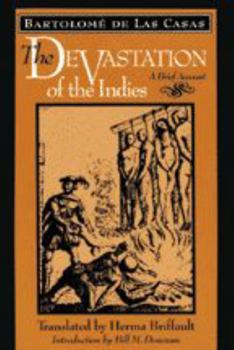
Paperback Devastation of the Indies: A Brief Account Book

ISBN: 0801844304

ISBN13: 9780801844300

Devastation of the Indies: A Brief Account

Select Format

Select Condition ThriftBooks Help Icon

Recommended

Format: Paperback

Condition: Good

$5.29
Save $27.66!
List Price $32.95
11 Available

Book Overview

Five hundred years after Columbus's first voyage to the New World, the debate over the European impact on Native American civilization has grown more heated than ever. Among the first--and most insistent--voices raised in that debate was that of a Spanish priest, Bartolome de Las Casas, acquaintance of Cortes and Pizarro and shipmate of Velasquez on the voyage to conquer Cuba. In 1552, after forty years of witnessing--and opposing--countless acts of brutality in the new Spanish colonies, Las Casas returned to Seville, where he published a book that caused a storm of controversy that persists to the present day. The Devastation of the Indies is an eyewitness account of the first modern genocide, a story of greed, hypocrisy, and cruelties so grotesque as to rival the worst of our own century. Las Casas writes of men, women, and children burned alive "thirteen at a time in memory of Our Redeemer and his twelve apostles." He describes butcher shops that sold human flesh for dog food ("Give me a quarter of that rascal there, " one customer says, "until I can kill some more of my own"). Slave ship captains navigate "without need of compass or charts, " following instead the trail of floating corpses tossed overboard by the ship before them. Native kings are promised peace, then slaughtered. Whole families hang themselves in despair. Once-fertile islands are turned to desert, the wealth of nations plundered, millions killed outright, whole peoples annihilated. In an introduction, historian Bill M. Donovan provides a brief biography of Las Casas and reviews the controversy his work produced among Europeans, whose indignation--and denials--lasted centuries. But the book itself is short. "Were I t describe all this, " writes Las Casas of the four decades of suffering he witnessed, "no amount of time and paper could encompass this task."

Customer Reviews

4 ratings

Good read

This first person account of the aftermath of Columbus and the Spanish is an important read from the time period. When so much has been misleading about the time period, at least form a public school textbook view, I found this book a necessary view of reality. Granted, the author completely agreed that the "natives" needed God, but he finally learned that the violence that accompanied the Spanish did not bring the Americans closer to God.

an important and terrifying work

There's certainly no denying the importance of de Las Casas' written account of the atrocities committed by the Spanish against the native inhabitants of Central and South America. Not only is the author's account moving and heart-breaking, but it's impact on the course of world events and public opinion have been quite profound (whether or not most people realize it). If you're an anthropology, history or social science student, you should definitely read this book. For the lay reader though, here is a word of caution: this isn't a personnal narrative about Las Casas' life in "the new world" or an ethnography. Focusing on the various kingdoms and territories destroyed by the Spanish, Las Casas uses a very standard format: the Spanish arrive, are treated with kindness by the native people, and then kill/rob/enslave anyone they can get their hands on. The accounts Las Casas provides are terrifying and tragic, yet they can become quite repetative. It's important to bear in mind that this book is the work of a humanitarian who wanted desperately to halt the brutality he saw happening around him; this is not a work of fiction meant to entertain. If you can look at this book for what it is, I think you can appreciate it.

Sweepingly urgent

Thanks in no small part to historians such as Howard Zinn, the words and images recorded by Bartolome de Las Casas are becoming more and more well-known to the general public. This short book is the ideal synopsis of Las Casas' work and attitudes. He writes with an almost palpable trembling while recording atrocity after atrocity visited upon the natives in America by the Spanish conquistadores. The translation is excellent and flows easily, making Las Casas' words all the more insistent and urgent. Most importantly, this book offers the reader a different understanding of the role Columbus and his successors played in the "New World." Even if readers do not agree with the conclusions drawn by Las Casas and succeeding social historians, the "Short Account" nonetheless provides a much needed perspective on the interaction between the Spanish and the natives--an interaction that has been insipidly named the "Columbian exchange" but in reality was only the prelude to massive genocidal fury. The "Short Account," written in the white heat of passion and anger, can devolve occassionally into pejoratives and ad hominems, but as the American abolitionist William Lloyd Garrison once said to critics: "I am aware that some object to the severity of my language, but is there not cause for severity?" Anyone with interest in American, European colonial, or native history should familiarize themselves with Las Casas; the "Short Account" is the best introduction available.

An insightful book

Bartolome was a priest in the new world and the book in an attempt to show the abuses that the Spaniards committed against the indians and the damages done in the name of Gad and the King. This book is a historiography, but well written and a quick read. It presents a new facet of the conquest and is a direct contrast to the writings of Cortes.
Copyright © 2025 Thriftbooks.com Terms of Use | Privacy Policy | Do Not Sell/Share My Personal Information | Cookie Policy | Cookie Preferences | Accessibility Statement
ThriftBooks ® and the ThriftBooks ® logo are registered trademarks of Thrift Books Global, LLC

GoDaddy Verified and Secured