
Skip to content
Scan a barcode
Scan
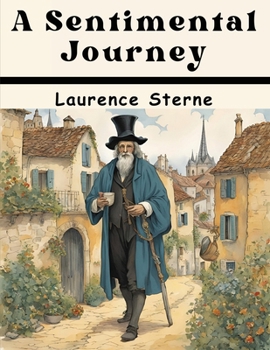
Paperback A Sentimental Journey Book

ISBN: 183657925X

ISBN13: 9781836579250

A Sentimental Journey

Select Format

Select Condition ThriftBooks Help Icon

Recommended

Format: Paperback

Condition: New

$13.29
Save $1.70!
List Price $14.99
Ships within 2-3 days
Save to List

Book Overview

A Sentimental Journey Through France and Italy by Laurence Sterne, published in 1768, is a witty and unconventional novel that blends travel writing, humor, and emotional introspection. Often considered a landmark in sentimental literature, the book offers a unique take on the genre by focusing on the internal experiences of its narrator rather than external events.

The novel follows the journey of Reverend Mr. Yorick, a thinly-veiled version of Sterne himself, as he travels through France and Italy. Unlike traditional travelogues of the time, Yorick's narrative is less concerned with geographical landmarks or detailed descriptions of foreign customs. Instead, it focuses on his interactions with the people he meets and his emotional and intellectual responses to these encounters.

The story is episodic, filled with a series of humorous and poignant vignettes. Yorick's experiences range from flirtatious exchanges with women to moments of compassion and moral reflection. He often muses on topics such as human nature, kindness, and the value of sentimentality in forging connections with others. His charm, wit, and impulsive nature create both comedic misunderstandings and touching moments.

The novel ends abruptly, as Sterne passed away before completing it, leaving Yorick's journey unfinished. This abrupt ending adds to the book's playful and experimental nature.

Themes

Sentimentality and Emotion: The novel celebrates emotional sensitivity and the value of empathy, reflecting the 18th-century "cult of sensibility."Travel as Self-Discovery: Yorick's journey becomes an exploration of his own character and emotions, emphasizing the internal over the external.Human Connection: The narrative highlights the importance of kindness and mutual understanding across cultural and social boundaries.Satire and Irony: Sterne gently mocks the conventions of both sentimental literature and traditional travelogues, often using humor and irony to subvert expectations.

Sterne's writing is playful and conversational, with frequent digressions, fragmented sentences, and an intimate narrative voice. His use of stream-of-consciousness and direct address to the reader creates a sense of immediacy and intimacy. The tone shifts between lighthearted humor and moments of genuine emotional depth.

A Sentimental Journey is considered a precursor to modern psychological and introspective novels. Its innovative narrative style and focus on emotion influenced later writers such as Jane Austen, Virginia Woolf, and James Joyce. The novel also helped popularize the sentimental genre, which emphasized the importance of feeling and human connection.

While Sterne's earlier work, Tristram Shandy, is more widely known for its experimental structure, A Sentimental Journey remains a beloved classic for its warmth, humor, and insightful exploration of human nature.

Customer Reviews

5 ratings

I wish I wish

I wish I could go around France and Italy and chat it up like this fellow does. I also wish I could write like him. Every once in a while I run across a writer who can really tell a tale and uses English as a painter uses oils. Ben

IN PRAISE OF DIGRESSION

The reader who expects Sterne's "Sentimental Journey" to provide something of an ordered travelogue will be disappointed. It is a seemingly artless web of loosely connnected episodes, anecdotes, impressions, musings. There is no structured narrative - one digression leads to another; some are amusing, some are absurd, some are thoughtful, but all of them are entertaining. My current rereading of the "Journey" was itself a digression. I had been watching a movie version of "Mansfield Park" that diverged significantly from Jane Austen's novel. In one scene (which is not in the novel) Henry Crawford tries to win Fanny Price's approval by reading her a passage from the "Sentimental Journey". (It is the scene with the caged starling calling "I can't get out - I can't get out" - a very poignant and appropriate selection, in my view). So you see - I had to reread both "Mansfield Park" and the "Journey" to fully appreciate the connection; and I don't regret it. The narrator of the "Journey" is Parson Yorick, a character introduced in Sterne's "Tristram Shandy", who owes as much to Shakespeare's jester as to Cervantes' Don Quixote. As he tells it, the journey came about in a haphazard manner. He had forgotten that England was at war with France and that he would need a passport. This leads to all sorts of complications and adventures, but in the end everything turns out just fine. His encounters with beggars and princes, innkeepers and shopkeepers are amusing and often revealing. The many temptations put in his way by mysterious ladies and obliging filles de chambre temporarily distract him from his purpose - but what is his purpose? The journey itself is the object of his quest. Some of his observations are rather sobering; e.g.,he concludes that we advance in life not by the favors we bestow but by the favors we receive, and that the surest way to success is through shameless flattery. Every politician knows that - but are the rest of us ready to admit it? There is a streak of cynicism running through Sterne's lightheartedness. Even the story of the starling, which supposedly teaches the narrator the value of freedom, ends on a note of bitter irony: the bird is passed fondly from hand to hand, but no one sets it free. As Sterne weaves into his tale characters and episodes from "Tristram Shandy", another digression is looming ahead: now we simply have to reread "Tristram Shandy"!

Journey of discovery

Even for modern readers, "A Sentimental Journey" (published 1768)is as startlingly innovative as Sterne's celebrated "Tristram Shandy". Sterne's ability to crystallize the minute details of experience - which may be down to a few seconds only - is reminiscent of Virginia Woolf's "To the Lighthouse". Indeed, Woolf admired this book. This is by no means an easy read. The 18th-century prose is difficult; the book is larded with Frenchisms and Biblical or classical allusions; the complex, slow narrative often requires re-reading. But the rewards are great! It's wise, deeply comical, and incredibly perceptive. There are several helpful reviews below dealing with the aspect of "sentimentality", and so I will just single out two things which appealed to me: 1. STERNE AND BODY LANGUAGE. Sterne shows an almost 20th-century appreciation of body language. In fact, I believe he might have been the first to identify it as such. His chapter, "The Translation", highlights the importance of being able to interpret subtle physical hints, like a language: "There is not a secret so aiding to the progress of sociality, as to get master of this _shorthand_, and be quick in rendering the several turns of looks and limbs, with all their inflections and delineations, into plain words." How visionary! 2. STERNE AND THE FRENCH. Ever since Shakespeare inserted a scene in "cod French" into _Henry V_, actually ever since the Norman Conquest and up to Monty Python and beyond, the English have revelled in mocking the French and their language. His Continental travelling gives Sterne the perfect excuse to do this. At one point he differentiates between "tant pis" (= "never mind" - where there is nothing to be gained) and "tant mieux" (= so much the better - where there IS an advantage). He also has a hilarious section on the grades of French swearing: first "Diable!", then "Peste!" and finally the words that he won't repeat. In all cases, Sterne carefully shows the social niceties of these expressions. The protagonist, Yorick, has various adventures of lust and feeling with women and other typically travelish things like losing his passport that we can all relate to. He's tender, obscene, learned, funny, companionable, and above all, readable - if tough.

Not just for scholars

Like Sterne's other works, _A Sentimental Journey_ is extraordinarily playful. His works are the eighteenth century's postmodernist works of play. They have lots of textual puzzles and tend toward the absurd. For example, the Mr. Yorick of the _Journey_ is also a character in Sterne's major novel _Tristram Shandy_ and is also the name under which he publishes his own sermons (he was a clergyman). The text is very "fragmentary" and the novel even jokes about that itself, labelling parts of itself "fragment." In these ways, the _Journey_ is fun and modern.But it is also indicative of an important eighteenth-century trend--sensibility or sentimentalism. All eras have their debates about the relationshp between the individual and society and this is one eighteenth-century answer. This opinion has nothing to do with "rights" but everything to do with "sympathy." Mr. Yorick, the "sentimental traveller," relates to other human beings through sympathetic physical responses, most notably the "pulses" and "beats" of his heart and hands for various women.Therefore, this book is a good way to get into a very different historical mindset while at the same time seeing the roots of some of the literary forms of today.

Only clay-cold heads and luke-warm hearts can resist it

A Sentimental Journey is a fabulous book for so many reasons. Laurence Sterne was an immensely influential writer in the 18th century--his major works, Sentimental Journey and Tristram Shandy, were responses to the travel narrative and newly born novel, respectively. His writing is essential to scholars of the 18th century--he is referenced in Austen's Mansfield Park and Northanger Abbey, Brown's The Power of Sympathy, Foster's The Coquette and Tyler's The Contrast. To understand and appreciate his novel is to have a better appreciation and love of the works that built their structures on his foundation. And yet it is original, as Yorick says himself, "both my travels and observations will be altogether of a different cast from any of my fore-runners."Yet it is not solely for historical benefit that one should read Sentimental Journey. The adventures and amours of Sterne's semi-autobiographical Yorick are delightful. One of the most romantic passages I've read in a book occurs when Yorick inadvertantly takes the hand of a woman and describes in detail the thrill of merely holding it. Granted, hers is not the only hand he will hold, but he writes so wonderfully, candidly and engagingly that it is extremely difficult to hold his passions against the sentimental Yorick. His scene with the starling locked in a cage is pertinent and a touching commentary on slavery. What a guy! My only complaint is the editor of this edition does not feel it necessary to translate the French-of which there is plenty-making some passages difficult to understand at best. However,this is a sentimental journey that I will gladly take over and over.
Copyright © 2026 Thriftbooks.com Terms of Use | Privacy Policy | Do Not Sell/Share My Personal Information | Cookie Policy | Cookie Preferences | Accessibility Statement
ThriftBooks ® and the ThriftBooks ® logo are registered trademarks of Thrift Books Global, LLC

GoDaddy Verified and Secured