


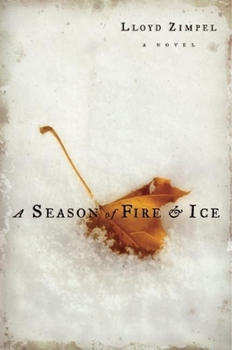
A Season of Fire and Ice: Excerpts from the Patriarch's Dakota Journal, with Addenda

Select Format
Select Condition 
Book Overview
From the heartlands of the 1880s Upper Midwest comes a morality tale of survival and destiny told in the convincing language of a patriarch's journal, evoking a real sense of the time and place.... This description may be from another edition of this product.
Format:Paperback
Language:English
ISBN:1932961364
ISBN13:9781932961362
Release Date:May 2007
Publisher:Unbridled Books
Length:256 Pages
Weight:0.68 lbs.
Dimensions:0.8" x 6.0" x 8.2"
Customer Reviews
4 ratings
Another Cowboy Book? No
Published by Thriftbooks.com User , 17 years ago
Focusing on the God versus man balance commonly endured by farmers of the midwest, Lloyd Zimpel's greatest efforts are not so much from the delicately delivered story, but by his unique manner of writing. Written as though by the patriarch in his journal, the cowboyesque sayings smattering on the pages richly depict the cowpokes' impressions of events amid and before them. In this case, Mr. Gerhard Praeger's perspective is highly touched, if not scarred, by his less than midwesternly friendly neighbor Leo Beidermann. Beidermann, when thinking of the hardships of his neighbors, coldly says, "I fail to understand it,. This whole crew here, none of `em at all, did a thing to taker personal credit for. They ain't done a thing themselves. Misfits and failures, went bust in the East; come crawling out here from New York or Pennsylvania, their grandpas did, and maybe got as far as Illinois or Wisconsin, and went bust there too. . ." Hard times are aplenty. But not for all. While others have stunted harvests from "drouth", grasshopper invasions, overly-burdensome winters, or just bad luck, Beidermann seems to avoid all impediments delivered by the gods. And, he bestows such fortune as a result of superior work. But, things change with the title's "fire." Before the fire, we learn about Beidermann's personality and how he has problems with most anyone about him. Masculine, and without gossip, he will not behave smarmy. He asks not, wants not. Praeger and family save him, twice, and receive little thanks. Their efforts do not ask for thanks, but their actions demand more than muted groans of appreciation. Beidermann is not their favorite neighbor. At times this book reminded me of Cather's classic "O Pioneers!" At other times, it reminds me of so many detailed and historically laden cowboy books. But, the journal-entry style is unique and different from most any other cowboy tale I have read. And, without any murders or mayhem it was delightfully less severe than many others read. Stylistically and topically, this book impressed me.
"How long can we live the frigid life, each day more icily daunting than the one before?"
Published by Thriftbooks.com User , 18 years ago
When homesteader Leo Biedermann arrives in the plains of South Dakota in January,1882, during the most severe weather the area has seen in years, he immediately begins building his house and barn, stocking the farm with cattle and horses, and planning his crops. Though he is not friendly, the other homesteaders help their neighbor when he needs machinery or a helping hand, and wish him well. When the first crops are harvested at the end of Biedermann's first summer, Biedermann has the largest crop of all. Told through the journal of Gerhardt Praeger, a long-term settler, the story of Biedermann and his relationships with the other homesteaders unfolds. Biedermann is a difficult man who travels with two ferocious dogs, and Praeger's first meeting with him has not been ideal. Over the course of five years, Biedermann miraculously prospers, through drought (during which he alone finds water on his property), floods which spare most of his fields, blizzards, and plagues of grasshoppers which bypass his land. Every other homesteader is devastated. This brutally realistic picture of life on the plains, in many ways a morality tale, honors the strength and stamina of the homesteaders in the face of terrible trials, but it is also a tribute to the values of these men and women, who share whatever they have, help each other, and never give up hope. Biedermann's success does stir secretly held feelings of jealousy, but these busy men and women often blame their own pride for the fact that they are not rewarded by God. Until, that is, Praeger's son Harris, with whom Biedermann has an argument, takes matters into his own hands and brings a devastating climax that Biedermann could never have expected. The narrative achieves excitement through the alternation of Praeger's journal with Interleaves reflecting other points of view and describing past history and present challenges--family backgrounds, the outbreak of a prairie fire, and various climatic disasters. Though the title can be considered in its literal sense--the prairie fires, blizzards, and bitter cold on the plains--it is also symbolic of the extremes of temperament which one sees between the fiery Harris and the icy Biedermann. Religious symbols pervade the novel--the fires of hell, miracles and the lack of miracles, pride as the cardinal sin. Since religion is as much a part of the homesteaders' reality as the sun and the rain, this symbolism complements author Lloyd Zimpel's crystalline prose, his almost biblical cadences, and the vibrant reality of the setting. Elegant and formal, with its universal themes, its focus on a unique time and place, its broad vision of humanity with all its glories and faults, and its lack of artifice and sentimentality, this 2006 novel already feels like an established classic. n Mary Whipple
"How long can we live the frigid life, each day more icily daunting than the one before?"
Published by Thriftbooks.com User , 18 years ago
When homesteader Leo Biedermann arrives in the plains of South Dakota in January,1882, during the most severe weather the area has seen in years, he immediately begins building his house and barn, stocking the farm with cattle and horses, and planning his crops. Though he is not friendly, the other homesteaders help their neighbor when he needs machinery or a helping hand, and wish him well. When the first crops are harvested at the end of Biedermann's first summer, Biedermann has the largest crop of all. Told through the journal of Gerhardt Praeger, a long-term settler, the story of Biedermann and his relationships with the other homesteaders unfolds. Biedermann is a difficult man who travels with two ferocious dogs, and Praeger's first meeting with him has not been ideal. Over the course of five years, Biedermann miraculously prospers, through drought (during which he alone finds water on his property), floods which spare most of his fields, blizzards, and plagues of grasshoppers which bypass his land. Every other homesteader is devastated. This brutally realistic picture of life on the plains, in many ways a morality tale, honors the strength and stamina of the homesteaders in the face of terrible trials, but it is also a tribute to the values of these men and women, who share whatever they have, help each other, and never give up hope. Biedermann's success does stir secretly held feelings of jealousy, but these busy men and women often blame their own pride for the fact that they are not rewarded by God. Until, that is, Praeger's son Harris, with whom Biedermann has an argument, takes matters into his own hands and brings a devastating climax that Biedermann could never have expected. The narrative achieves excitement through the alternation of Praeger's journal with Interleaves reflecting other points of view and describing past history and present challenges--family backgrounds, the outbreak of a prairie fire, and various climatic disasters. Though the title can be considered in its literal sense--the prairie fires, blizzards, and bitter cold on the plains--it is also symbolic of the extremes of temperament which one sees between the fiery Harris and the icy Biedermann. Religious symbols pervade the novel--the fires of hell, miracles and the lack of miracles, pride as the cardinal sin. Since religion is as much a part of the homesteaders' reality as the sun and the rain, this symbolism complements author Lloyd Zimpel's crystalline prose, his almost biblical cadences, and the vibrant reality of the setting. Elegant and formal, with its universal themes, its focus on a unique time and place, its broad vision of humanity with all its glories and faults, and its lack of artifice and sentimentality, this 2006 novel already feels like an established classic. n Mary Whipple
superb historical
Published by Thriftbooks.com User , 19 years ago
Gerhardt Praeger, an educated farmer, appreciates his pragmatic wife Ma as they raise seven sons on the often hostile Dakota plains. He begins to write his thoughts of events in a journal (diaries are for females) starting in 1882 with the new settler Leo Beidierman and the Swede's widow. Over the years as he often scribes in his journal Gerhardt finds Beiderman's success and luck unbelievable and envies the man especially after Beiderman befriends his two youngest sons. Still when natural disasters occur, all the people residing nearby help one another even when they are jealous of one of them. A SEASON OF FIRE AND ICE is a superb historical that provides insight into the harsh life of living in the Dakota during the 1880s. Nature plays such a strong role in shaping the residents that it is more than just background, it serves as a powerful antagonist at times with floods, blizzards, and droughts often. Loyalty within families and with neighbors is the norm when calamity happens whether that be man-made or natural. Americana readers will enjoy this first hand fictionalized account (and its "interleafs") of five years in the lives of people in the late nineteenth century. Harriet Klausner
Copyright © 2026 Thriftbooks.com Terms of Use
| Privacy Policy | Do Not
Sell/Share My Personal Information | Cookie Policy | Cookie Preferences | Accessibility Statement
ThriftBooks® and the ThriftBooks® logo are registered trademarks of Thrift Books Global, LLC
ThriftBooks® and the ThriftBooks® logo are registered trademarks of Thrift Books Global, LLC
