


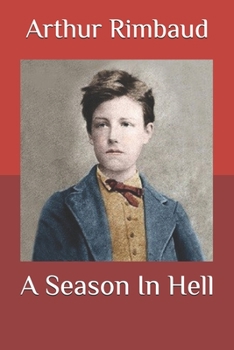
A Season In Hell


Select Format
Select Condition 
Book Overview
DELIRIUM II ALCHEMY OF THE WORDMy turn: the story of my foolishness. For ages I boasted of possessing all possible landscapes, and found the celebrities of modern painting and poetry absurd. I loved idiotic pictures, painted panels, stage sets, backdrops, hotel signs, popular prints; unfashionable literature, church Latin, erotic books with poor spelling, bygone novels, fairy tales, little books for children, old operas, inane refrains, syncopated rhythms. I dreamt of crusades, unrecorded voyages of discovery, republics without histories, wars of suppressed religion, moral revolutions, movements of races and continents: I believed in every enchantment. I invented the color of vowels A black, E white, I red, O blue, U green. - I regulated the form and motion of every consonant, and, with instinctive rhythms, I flattered myself I'd created a poetic language, accessible some day to all the senses. I reserved the translation rights. It was academic at first. I wrote of silences, nights, I made note of the inexpressible. I fixated on frenzies...Far from the flocks of birds and village girls, On my knees, what did I drink in the heather?Surrounded by a tender grove of trees, In a green mist, what did I drink on that warm afternoon?What could I be drinking?Voiceless trees, flowerless turf, an ominous sky -From yellow gourds, far from my hut, I perspired as I drank golden liquors.My silhouette was like a dubious sign for a strange hotel - A storm blew in. That evening, the wind of God Brought ice to the pond: - I could no longer drink: I saw gold, I wept The old poetry played a part in my alchemy of the word.I became accustomed to pure hallucination: I saw quite clearly a mosque instead of a factory, a school of drummers led by angels, carriages on the highway of the sky, a salon in the depths of a lake; monsters, mysteries; a performance, a skit, conjured up horrors before me.Then I explained my magical sophisms with hallucinatory words I ended by treating my mental disorder as sacred. I was idle, prey to a heavy fever: I envied the happiness of beasts - caterpillars: that represent Limbo's innocence, moles: the sleep of virginity My character was embittered. I said farewell to the world in song: SONG OF THE HIGHEST TOWERMay it come, the time of love, The time we would be enamored of.I've been patient so longI have forgottenAll fears and sufferingThey've flown up into skies.My veins burst, I thirst.May it come, the time of love, The time we would be enamored of.So the meadowFreed by neglect, Flowered, overgrownWith weeds and incense, To the buzz nearbyOf foul flies.May it come, the time of love, The time we would be enamored of.
Format:Paperback
Language:English
ISBN:1520121695
ISBN13:9781520121697
Release Date:December 2016
Publisher:Independently Published
Length:78 Pages
Weight:0.32 lbs.
Dimensions:0.2" x 6.0" x 9.0"
Customer Reviews
5 ratings
The hell within
Published by Thriftbooks.com User , 25 years ago
These are the brilliant and mystical hallucinations of the original "enfant terrible" and his visionary raptures about poetry, innocence and guilt. Verbal deliriums suffused with pain and hatred, remorse and desperation, but also with a parodic, pathetic and fatalistic megalomania. The "mystical rage" transformed into pyromaniac wording. Poems in prose, of very high quality, which reflect the fury of the love-hate relationship of Rimbaud with life and Universe.
Anguished and Brilliant
Published by Thriftbooks.com User , 26 years ago
In the collection of prose poems and verse fragments that make up the short book A Season in Hell, begun in April 1873 in an outbuilding at Rimbaud's family farm at the village of Roche and completed by the end of August, he looks back in despair over his life as a poet. In one of the fragments, titled "Ravings number two" he talks about "the history of one of my follies." "I invented the colors of the vowels!" he claims, and goes on: "I flattered myself that I had created a poetic language accessible...to all the senses...I expressed the inexpressible. I defined vertigos...I ended up regarding my mental disorder as sacred." Rimbaud draws a picture of his affair with Verlaine in cynical terms, painting Verlaine as a weak and foolish virgin and himself as an "infernal bridegroom," a monster of cruelty. It wasn't far from the truth.The last chapter of A Season in Hell is titled "Farewell." It has an air of exhaustion and relief about it. "I have tried to invent new flowers, new stars, new flesh, new tongues. I believed I had acquired supernatural powers. Well! I must bury my imagination and my memories. A fine fame as an artist and story-teller swept away! I! I who called myself magus or angel, exempt from all morality, I am given back to the earth, with a task to pursue, and wrinkled reality to embrace. A peasant!" A Season In Hell was finished in August 1873. Rimbaud somehow persuaded his thrifty mother to pay to have the book printed in Belgium. He sent his six author's copies to his friends and to men of letters in Paris. Many people see this manuscript as his farewell to literature. It certainly reads like that, although Enid Starkie believes that it was Rimbaud's farewell to a certain kind of literature--visionary, mystical, growing out of the selfish and hallucinatory lifestyle that had crashed to a halt only a few months before with his shooting and the jailing of Verlaine--and a commitment to something more humble and realistic. "Well, now I shall ask forgiveness for having fed on lies," Rimbaud wrote. He hoped that the French literary world would offer him the forgiveness that he was now prepared to seek, and give his book favorable reviews. He the proceeded to Paris to see how his book had fared.Favorable reviews? He must have been mad. To those literary men, the dilettantes Rimbaud had mocked and despised a year or two earlier, Rimbaud was the insolent catamite who had destroyed their old friend Verlaine: sponged off him, wrecked his marriage, corrupted his soul and ruined his life, and then, when he had used him up, had turned him in to the police to face hard labor in a Belgian jail.We have an eyewitness account of Rimbaud on the day when the last door in Paris had been slammed in his face, at the moment when he realized that the literary career he'd embraced so passionately was over. It was the evening of the first of November, 1873, a holiday, and the cafés and restaurants were crowded. The poet Poussin
Anguished and Brilliant
Published by Thriftbooks.com User , 26 years ago
In the collection of prose poems and verse fragments that make up the short book A Season in Hell, begun in April 1873 in an outbuilding at Rimbaud's family farm at the village of Roche and completed by the end of August, he looks back in despair over his life as a poet. In one of the fragments, titled "Ravings number two" he talks about "the history of one of my follies. I invented the colors of the vowels!" he claims, and goes on: "I flattered myself that I had created a poetic language accessible...to all the senses...I expressed the inexpressible. I defined vertigos...I ended up regarding my mental disorder as sacred." Rimbaud draws a picture of his affair with Verlaine in cynical terms, painting Verlaine as a weak and foolish virgin and himself as an "infernal bridegroom," a monster of cruelty. It wasn't far from the truth.The last chapter of A Season in Hell is titled "Farewell." It has an air of exhaustion and relief about it. "I have tried to invent new flowers, new stars, new flesh, new tongues. I believed I had acquired supernatural powers. Well! I must bury my imagination and my memories. A fine fame as an artist and story-teller swept away! I! I who called myself magus or angel, exempt from all morality, I am given back to the earth, with a task to pursue, and wrinkled reality to embrace. A peasant!" A Season In Hell was finished in August 1873. Rimbaud somehow persuaded his thrifty mother to pay to have the book printed in Belgium. He sent his six author's copies to his friends and to men of letters in Paris. Many people see this manuscript as his farewell to literature. It certainly reads like that, although Enid Starkie believes that it was Rimbaud's farewell to a certain kind of literature--visionary, mystical, growing out of the selfish and hallucinatory lifestyle that had crashed to a halt only a few months before with his shooting and the jailing of Verlaine--and a commitment to something more humble and realistic. "Well, now I shall ask forgiveness for having fed on lies," Rimbaud wrote. He hoped that the French literary world would offer him the forgiveness that he was now prepared to seek, and give his book favorable reviews. He the proceeded to Paris to see how his book had fared.Favorable reviews? He must have been mad. To those literary men, the dilettantes Rimbaud had mocked and despised a year or two earlier, Rimbaud was the insolent catamite who had destroyed their old friend Verlaine: sponged off him, wrecked his marriage, corrupted his soul and ruined his life, and then, when he had used him up, had turned him in to the police to face hard labour in a Belgian jail.We have an eyewitness account of Rimbaud on the day when the last door in Paris had been slammed in his face, at the moment when he realized that the literary career he'd embraced so passionately was over. It was the evening of the first of November, 1873, a holiday, and the cafés and restaurants were crowded. The poet Poussin
Timeless poetry merges with wonderfull photography.
Published by Thriftbooks.com User , 27 years ago
Truely a great moment in literature. The marraige of Rimbaud's words with the eye of Mapplethorpe makes this thin volume a classic. Paul Schmidt's introduction shed considerable light on Rimbaud's use of certain words and his translation of this piece is beautiful. The photographs are breathtaking. A must have for anyone who admires the work of either of these fine artists.
a desperate hallucinatory journey
Published by Thriftbooks.com User , 28 years ago
this is perhaps one of the most bizarre epics ever written, with a million possible interpretations. it is essentially a book about descent into hell and getting out again. a brilliant love poem that hardly seems so. recommended for all those in love baudelaire, symbolism, or surrealism.
Copyright © 2026 Thriftbooks.com
Terms of Use | Privacy Policy | Do Not Sell/Share My Personal Information | Cookie Notice | Cookie Preferences | Accessibility Statement
ThriftBooks ® and the ThriftBooks ® logo are registered trademarks of Thrift Books Global, LLC
ThriftBooks ® and the ThriftBooks ® logo are registered trademarks of Thrift Books Global, LLC
