
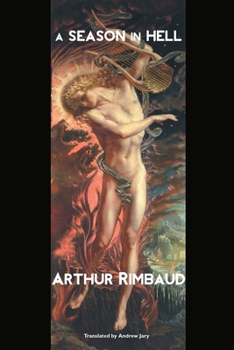
ARTHUR RIMBAUD: A SEASON IN HELLEdited and translated by Andrew JaryLarge Print EditionA new translation of Arthur Rimbaud's extraordinary poetic statement, written in 1873. The sensual, violent and anguished emotion in Rimbaud's visionary 'alchemy of the word' remains startling, and continues to inspire poets. Printed with the French text facing the translation. With a full colour laminate cover. For a time, when he was a teenager until he was 19, art was crucial for the psychic well-being of the restless Arthur Rimbaud (1854-1891). The young would-be rebel Rimbaud escaped from the bland provincial town of Charleville in Northern France to wander the streets of Paris in poverty. After writing his Illuminations and A Season in Hell, some of the most extraordinary poems of all world literature, Rimbaud renounced it all for a hellish and apparently boring life in Aden. 'Mortel, ange ET demon, autant dire Rimbaud, ' as Rimbaud's lover, Paul Verlaine wrote ('Mortal, angel AND demon, that is to say Rimbaud'.)Arthur Rimbaud is the tornado of world poetry. He out-blasts just about every other poet. For poets, he is more significant than the so-called 'founding fathers' or influential philosophers of modern times: Marx, Freud, Nietzsche and Einstein. For poets, he is 'everybody's favourite hippy', a Communard, a 'precursor of the current movement of subversion of Western notions of self, society, and discourse', and a savage mystic.Introduction, bibliography and notes. Includes 4 pages of new illustrations. www.crmoon.com
These are the brilliant and mystical hallucinations of the original "enfant terrible" and his visionary raptures about poetry, innocence and guilt. Verbal deliriums suffused with pain and hatred, remorse and desperation, but also with a parodic, pathetic and fatalistic megalomania. The "mystical rage" transformed into pyromaniac wording. Poems in prose, of very high quality, which reflect the fury of the love-hate relationship of Rimbaud with life and Universe.
Anguished and Brilliant
Published by Thriftbooks.com User , 25 years ago
In the collection of prose poems and verse fragments that make up the short book A Season in Hell, begun in April 1873 in an outbuilding at Rimbaud's family farm at the village of Roche and completed by the end of August, he looks back in despair over his life as a poet. In one of the fragments, titled "Ravings number two" he talks about "the history of one of my follies." "I invented the colors of the vowels!" he claims, and goes on: "I flattered myself that I had created a poetic language accessible...to all the senses...I expressed the inexpressible. I defined vertigos...I ended up regarding my mental disorder as sacred." Rimbaud draws a picture of his affair with Verlaine in cynical terms, painting Verlaine as a weak and foolish virgin and himself as an "infernal bridegroom," a monster of cruelty. It wasn't far from the truth.The last chapter of A Season in Hell is titled "Farewell." It has an air of exhaustion and relief about it. "I have tried to invent new flowers, new stars, new flesh, new tongues. I believed I had acquired supernatural powers. Well! I must bury my imagination and my memories. A fine fame as an artist and story-teller swept away! I! I who called myself magus or angel, exempt from all morality, I am given back to the earth, with a task to pursue, and wrinkled reality to embrace. A peasant!" A Season In Hell was finished in August 1873. Rimbaud somehow persuaded his thrifty mother to pay to have the book printed in Belgium. He sent his six author's copies to his friends and to men of letters in Paris. Many people see this manuscript as his farewell to literature. It certainly reads like that, although Enid Starkie believes that it was Rimbaud's farewell to a certain kind of literature--visionary, mystical, growing out of the selfish and hallucinatory lifestyle that had crashed to a halt only a few months before with his shooting and the jailing of Verlaine--and a commitment to something more humble and realistic. "Well, now I shall ask forgiveness for having fed on lies," Rimbaud wrote. He hoped that the French literary world would offer him the forgiveness that he was now prepared to seek, and give his book favorable reviews. He the proceeded to Paris to see how his book had fared.Favorable reviews? He must have been mad. To those literary men, the dilettantes Rimbaud had mocked and despised a year or two earlier, Rimbaud was the insolent catamite who had destroyed their old friend Verlaine: sponged off him, wrecked his marriage, corrupted his soul and ruined his life, and then, when he had used him up, had turned him in to the police to face hard labor in a Belgian jail.We have an eyewitness account of Rimbaud on the day when the last door in Paris had been slammed in his face, at the moment when he realized that the literary career he'd embraced so passionately was over. It was the evening of the first of November, 1873, a holiday, and the cafés and restaurants were crowded. The poet Poussin
Anguished and Brilliant
Published by Thriftbooks.com User , 25 years ago
In the collection of prose poems and verse fragments that make up the short book A Season in Hell, begun in April 1873 in an outbuilding at Rimbaud's family farm at the village of Roche and completed by the end of August, he looks back in despair over his life as a poet. In one of the fragments, titled "Ravings number two" he talks about "the history of one of my follies. I invented the colors of the vowels!" he claims, and goes on: "I flattered myself that I had created a poetic language accessible...to all the senses...I expressed the inexpressible. I defined vertigos...I ended up regarding my mental disorder as sacred." Rimbaud draws a picture of his affair with Verlaine in cynical terms, painting Verlaine as a weak and foolish virgin and himself as an "infernal bridegroom," a monster of cruelty. It wasn't far from the truth.The last chapter of A Season in Hell is titled "Farewell." It has an air of exhaustion and relief about it. "I have tried to invent new flowers, new stars, new flesh, new tongues. I believed I had acquired supernatural powers. Well! I must bury my imagination and my memories. A fine fame as an artist and story-teller swept away! I! I who called myself magus or angel, exempt from all morality, I am given back to the earth, with a task to pursue, and wrinkled reality to embrace. A peasant!" A Season In Hell was finished in August 1873. Rimbaud somehow persuaded his thrifty mother to pay to have the book printed in Belgium. He sent his six author's copies to his friends and to men of letters in Paris. Many people see this manuscript as his farewell to literature. It certainly reads like that, although Enid Starkie believes that it was Rimbaud's farewell to a certain kind of literature--visionary, mystical, growing out of the selfish and hallucinatory lifestyle that had crashed to a halt only a few months before with his shooting and the jailing of Verlaine--and a commitment to something more humble and realistic. "Well, now I shall ask forgiveness for having fed on lies," Rimbaud wrote. He hoped that the French literary world would offer him the forgiveness that he was now prepared to seek, and give his book favorable reviews. He the proceeded to Paris to see how his book had fared.Favorable reviews? He must have been mad. To those literary men, the dilettantes Rimbaud had mocked and despised a year or two earlier, Rimbaud was the insolent catamite who had destroyed their old friend Verlaine: sponged off him, wrecked his marriage, corrupted his soul and ruined his life, and then, when he had used him up, had turned him in to the police to face hard labour in a Belgian jail.We have an eyewitness account of Rimbaud on the day when the last door in Paris had been slammed in his face, at the moment when he realized that the literary career he'd embraced so passionately was over. It was the evening of the first of November, 1873, a holiday, and the cafés and restaurants were crowded. The poet Poussin
Timeless poetry merges with wonderfull photography.
Published by Thriftbooks.com User , 27 years ago
Truely a great moment in literature. The marraige of Rimbaud's words with the eye of Mapplethorpe makes this thin volume a classic. Paul Schmidt's introduction shed considerable light on Rimbaud's use of certain words and his translation of this piece is beautiful. The photographs are breathtaking. A must have for anyone who admires the work of either of these fine artists.
a desperate hallucinatory journey
Published by Thriftbooks.com User , 27 years ago
this is perhaps one of the most bizarre epics ever written, with a million possible interpretations. it is essentially a book about descent into hell and getting out again. a brilliant love poem that hardly seems so. recommended for all those in love baudelaire, symbolism, or surrealism.
ThriftBooks sells millions of used books at the lowest
everyday prices. We personally assess every book's quality and offer rare, out-of-print treasures. We
deliver the joy of reading in recyclable packaging with free standard shipping on US orders over $15.
ThriftBooks.com. Read more. Spend less.

