


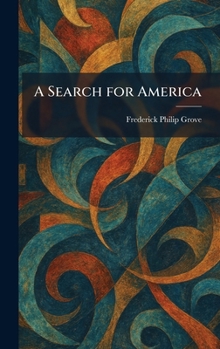
A Search for America

"A Search for America" is a seminal work of Canadian literature that explores the profound and often grueling experience of immigration at the turn of the 20th century. The narrative follows Philip Branden, a young European intellectual who arrives in the United States with high expectations, only to be confronted by the stark realities of manual labor and social stratification. As Branden traverses the continent, from the bustling streets of New York to the vast landscapes of the Canadian prairies, he undergoes a spiritual and physical odyssey that challenges his preconceived notions of the "New World."
Frederick Philip Grove's masterpiece is celebrated for its vivid social realism and its deep psychological insight into the immigrant psyche. The work serves as both a critique of the elusive American Dream and a testament to the resilience of the human spirit in the face of displacement. Often categorized as a semi-autobiographical novel, "A Search for America" remains a vital touchstone for understanding the historical development of North American identity and the literary landscape of the early 20th century. It offers readers a powerful reflection on class, culture, and the search for a place to belong.
This work has been selected by scholars as being culturally important, and is part of the knowledge base of civilization as we know it. This work was reproduced from the original artifact, and remains as true to the original work as possible. Therefore, you may see the original copyright references, library stamps (as most of these works have been housed in our most important libraries around the world), and other notations in the work.
This work is in the public domain in the United States of America, and possibly other nations. Within the United States, you may freely copy and distribute this work, as no entity (individual or corporate) has a copyright on the body of the work.
As a reproduction of a historical artifact, this work may contain missing or blurred pages, poor pictures, errant marks, etc. Scholars believe, and we concur, that this work is important enough to be preserved, reproduced, and made generally available to the public. We appreciate your support of the preservation process, and thank you for being an important part of keeping this knowledge alive and relevant.
Customer Reviews
ThriftBooks ® and the ThriftBooks ® logo are registered trademarks of Thrift Books Global, LLC
