


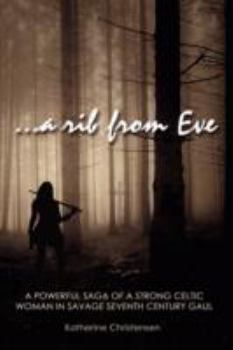
A Rib from Eve: A Powerful Saga of Strong Celtic Women in Savage, Tumultous, Seventh Century Gaul

Malgven, daughter of Merovingian King Dagobert I, is afforded the finest education available in the 7th century. After she witnesses the savage murder of her Saxon mother for sorcery, Malgven's mind... This description may be from another edition of this product.
Format:Paperback
Language:English
ISBN:1595268502
ISBN13:9781595268501
Release Date:August 2008
Publisher:Llumina Pr
Length:352 Pages
Weight:1.19 lbs.
Dimensions:8.8" x 1.0" x 5.8"
Customer Reviews
4 ratings
A fast paced fantasy of an intriguing era
Published by Thriftbooks.com User , 17 years ago
Before the time of Christianity, the pagan religions of Europe regarded women as equals to men in society. All that soon changed. "...A Rib From Eve: A Powerful Saga of a Strong Celtic Woman in Savage Seventh Century Gaul" is the story of a pagan woman who lived much of her life on the fringes of the rapidly spreading Christian society. Telling the story of one of the last princesses of this era, she details her struggles of survival as she finds herself accused of witchcraft, and barely escaping her sentence. A fast paced fantasy of an intriguing era not often discussed, "...A Rib from Eve" is very highly recommended reading.
Adventure and Romance embedded in Medieval history
Published by Thriftbooks.com User , 17 years ago
A Rib from Eve is about an amazing line of women living in turbulent times. A friend of mine loaned me her copy - she highly recommended it as an unusual and captivating book. I am adding a copy to my own library as it is a book I will likely pick up and read again and again. The book paints and amazing backdrop of a world on the verge of civilization, but not quite there yet. Druid mysticism, savage clashes between the Merovingian Kings and their neighbors, Celtic lore, and the tug of a not yet civilized Christian influence, made it hard for me to put this book down. The main character, Malgven, captured my heart. When her mother is burned for sorcery, her father, King Dagobert, ravages the countryside in revenge. The time Malgven spends with her Grandmother, Levinia, and her wild Saxon cousins was so entertaining. I was delighted with Cantus, one of her young Druid companions, who had a very odd obsession with spiders. As an animal lover, the nature backdrops really connected for me. The romance between Malgven and the King of the Bretons is a real page turner. What is really unusual for a fiction novel is detailed footnotes in the book. I noticed another reviewer did not care for that, but I think it makes the reading more enjoyable and provides a rich reading experience within a fiction novel based on unusual facts. I could read this book several times and still find something new. The characters in this novel were brought to vibrant life for me. I highly recommend A Rib From Eve and look forward to the hinted sequel!
Historical Fiction About Overlooked Merovingian France
Published by Thriftbooks.com User , 17 years ago
Reviewed by Tyler R. Tichelaar for Reader Views (12/08) I was eager to read "...a rib from Eve" because it is set during the seventh century in Merovingian France and depicts the conflict between the old Celtic religion and Christianity. Many other novels have been written in the last few decades about this conflict, but primarily they are set in the British Isles--many circling around the reign of King Arthur or the life of St. Patrick. "...a rib from Eve" is the first I am familiar with set in France during the reign of the Merovingian kings. The back cover states of the author "Bringing the saga of her female ancestral role models to life is her passion." I was intrigued by that statement because I have traced my own family tree back to the Merovingian Kings of France, so I wanted to learn more about them, and I found many of my ancestors depicted in the novel. The novel weaves together a great deal of history, using significant historical characters such as King Dagobert I, but also blending in fictional characters, including his daughter, Malgven, who is at the center of the novel. The novel does not have much of a plot, but rather is the life story of Malgven, from before her birth, describing her parents and their meeting, and then through to Malgven's death. Throughout the novel, we learn about the politics and culture of Merovingian France, especially the roles of religion and women during this time. While the entire concept of the novel intrigued me, I found it slow reading. I felt the author was far too descriptive, which affected the pacing. Descriptions of animals' movements and other superfluous details could have been edited out to provide a faster pace. There was no driving force to the story, no suspenseful issue in the first pages that must be resolved to keep the reader reading. It was less a novel with a proper conflict, than just a story about the characters. However, people interested in history may not mind the lack of conflict in the novel, and they will learn a great deal about the time period depicted. The characters themselves were well-developed, likeable, and their motivations clearly defined so they never acted out of character. While the novel was well-researched, I felt the research often got in the way of the story, the excessive details often weighing it down. The novel contains nearly three-hundred footnotes, which I found distracting. Footnotes don't belong in novels. Most of them were unnecessary; the meanings mostly clear in the text as they should have been. The author provides a list of all the characters with brief facts, but I found it difficult to refer to this list because the characters were not listed alphabetically. While the characters listed were historical, very little historical information was provided about them, and instead the author explained how the character was depicted in the novel. I would have preferred an afterword where the author talked about the research she did and the histori
A well-researched story of strong Celtic women in 7th-century Europe
Published by Thriftbooks.com User , 17 years ago
There are two similar incidents early in this fictional account of fierce seventh century women. A character's spirit enters another human being who is undergoing some kind of misfortune and afterwards awakes from the dream. In essence, that is what storytelling is all about--entering the dilemma of another and then later, when the episode is over, returning to real life. Addressing this participation in myth, particularly within the context of the history we are reading here, is a brilliant stroke of artistry. And immersed in the story we are, for Katherine Christensen has done exhaustive research on the time period of her subject. We not only get a map, cryptic messages and footnotes, but also key words we can use to Google more--something I've never seen before. There are some romance-writer flourishes in the first half, but they never take over this Celtic tale of intrigue, cruelty, wonder and revenge. I particularly like the father/daughter, mother/daughter and father/son relationships as they make the progression from one generation to the next seem real. It was a time when pagan culture came in conflict with a patriarchal Catholic Church. The second half of the book deals more with the clergy becoming fed up with the power and influence Celtic women exerted over their men, "Was a gift for prophecy sorcery...or a miracle?" The writing is clear and well edited. Perhaps, as with history books, there is a bit too much narrative summary. Though, through the interaction of Boethius with the girl the young princess, Malgven, (he is her teacher) we do learn some interesting things about the Pythagorean music of the spheres and the great "salmon of knowledge." Because we care about the characters, the mob's burning of Gomatrud is a shock especially since we see it through the eyes of her daughter (the mother is outcast because she is unable to have a male heir). Years later we are at that girl's deathbed--she is an old woman with a daughter of her own. Dialogue and interaction among characters is credible. I felt a bit overwhelmed by the scope of material and the number of people involved, but there is a useful directory of characters in the back as well as an extensive bibliography. Be warned this is a long book, and its journey is continued in another. We often think of early history in terms of men--whether warriors, profits or kings. This book gives us strong women doing bold and courageous things. The title plays with this, but I can't think of a message that is more profound for today.
Copyright © 2026 Thriftbooks.com Terms of Use
| Privacy Policy | Do Not
Sell/Share My Personal Information | Cookie Policy | Cookie Preferences | Accessibility Statement
ThriftBooks® and the ThriftBooks® logo are registered trademarks of Thrift Books Global, LLC
ThriftBooks® and the ThriftBooks® logo are registered trademarks of Thrift Books Global, LLC
