


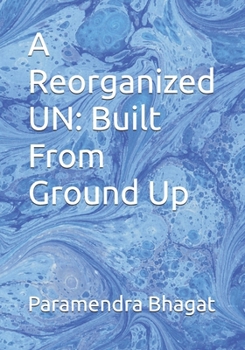
A Reorganized UN: Built From Ground Up

This book presents a bold and urgent call to dissolve the outdated post-World War II United Nations and replace it with a new, democratic, technologically modern, and morally grounded global institution. It argues that the current UN, with its unrepresentative Security Council, paralyzing veto structure, and colonial-era power imbalances, is incapable of addressing today's interconnected planetary crises-from climate collapse and AI governance to pandemic threats and global inequality.
At the heart of the proposed solution is the 40-40-20 formula for decision-making: 40% voting power based on global population, 40% on GDP, and 20% reserved equally for all countries. This model balances the principles of democracy, contribution, and sovereignty-replacing great-power domination with inclusive legitimacy.
The book traces how historical power structures-from colonial empires to modern data empires-continue to distort global governance and suppress the voices of the Global South. It lays out how a reorganized UN could cut military budgets by trillions and redirect resources toward peacebuilding, sustainability, and equitable development.
Key reforms include:
Replacing the Security Council with a Peace Council that rotates membership and bans vetoes;
Establishing a Global Commons Authority to govern climate, oceans, and AI;
Replacing the WTO with a Trade and Development Forum aligned with sustainable development goals;
Introducing five working languages-Mandarin, English, Hindi, Spanish, and Arabic-to ensure global participation;
Creating a digital-first infrastructure that empowers citizens directly through transparent deliberation and secure voting.
Through illustrative examples, policy blueprints, and a detailed implementation roadmap, the book shows how a coalition of 50+ countries can convene a modern "San Francisco Conference" to ratify a new global charter, establish core institutions, and begin transitioning from the old UN within a decade.
Special attention is given to the roles that the United States, India, small countries, and the Global South can play in forging this new multilateral order. The book argues that far from being a utopian dream, this project is both strategically feasible and historically precedented-just as the UN replaced the League of Nations in 1945.
Ultimately, A Reorganized UN: Built From Ground Up is not just a critique-it is a plan. It offers a visionary yet practical framework to build a global institution capable of ensuring peace, protecting our commons, and restoring trust in collective humanity. It is a blueprint for global governance in the 21st century-grounded in justice, powered by technology, and led by people, not empires.
Customer Reviews
ThriftBooks® and the ThriftBooks® logo are registered trademarks of Thrift Books Global, LLC
