


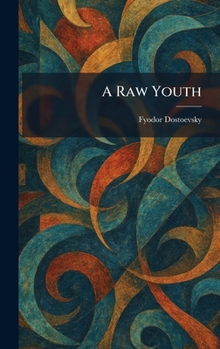
A Raw Youth

"A Raw Youth" is a profound psychological novel by Fyodor Dostoevsky that explores the turbulent transition from adolescence to adulthood in 19th-century Russia. The narrative follows Arkady Dolgoruky, an illegitimate son of a dissipated landowner, as he arrives in St. Petersburg with a personal "idea" to become as wealthy as a Rothschild. However, his ambitions are quickly complicated by his deep-seated desire for recognition from his biological father, Versilov, and his immersion into a world of scandal, debt, and moral ambiguity.
As Arkady navigates the complex social strata of the city, he finds himself caught between the old aristocratic values and the radical ideologies of the younger generation. Dostoevsky masterfully portrays the internal conflicts of a young man seeking his place in a chaotic society, touching on themes of family loyalty, social identity, and the search for spiritual meaning. "A Raw Youth" stands as a significant work in Dostoevsky's bibliography, offering a detailed character study and a vivid depiction of the existential crises that defined the era. Through Arkady's eyes, readers witness the struggle to maintain integrity in a world fraught with deception and the enduring quest for redemption.
This work has been selected by scholars as being culturally important, and is part of the knowledge base of civilization as we know it. This work was reproduced from the original artifact, and remains as true to the original work as possible. Therefore, you may see the original copyright references, library stamps (as most of these works have been housed in our most important libraries around the world), and other notations in the work.
This work is in the public domain in the United States of America, and possibly other nations. Within the United States, you may freely copy and distribute this work, as no entity (individual or corporate) has a copyright on the body of the work.
As a reproduction of a historical artifact, this work may contain missing or blurred pages, poor pictures, errant marks, etc. Scholars believe, and we concur, that this work is important enough to be preserved, reproduced, and made generally available to the public. We appreciate your support of the preservation process, and thank you for being an important part of keeping this knowledge alive and relevant.
Customer Reviews
ThriftBooks® and the ThriftBooks® logo are registered trademarks of Thrift Books Global, LLC
