


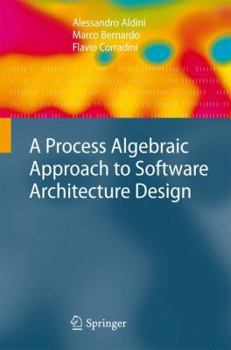
A Process Algebraic Approach to Software Architecture Design
No Customer Reviews

Select Format
Select Condition 
Book Overview
Inthe?eldofformalmethodsincomputerscience, concurrencytheoryisreceivinga constantlyincreasinginterest.Thisisespeciallytrueforprocessalgebra.Althoughit had been originally conceived as a means for reasoning about the semantics of c- current programs, process algebraic formalisms like CCS, CSP, ACP, ?-calculus, and their extensions (see, e.g., 154,119,112,22,155,181,30]) were soon used also for comprehendingfunctionaland nonfunctionalaspects of the behaviorof com- nicating concurrent systems. The scienti?c impact of process calculi and behavioral equivalences at the base of process algebra is witnessed not only by a very rich literature. It is in fact worth mentioningthe standardizationprocedurethat led to the developmentof the process algebraic language LOTOS 49], as well as the implementation of several modeling and analysis tools based on process algebra, like CWB 70] and CADP 93], some of which have been used in industrial case studies. Furthermore, process calculi and behavioral equivalencesare by now adopted in university-levelcourses to teach the foundations of concurrent programming as well as the model-driven design of concurrent, distributed, and mobile systems. Nevertheless, after 30 years since its introduction, process algebra is rarely adopted in the practice of software development. On the one hand, its technica- ties often obfuscate the way in which systems are modeled. As an example, if a process term comprises numerous occurrences of the parallel composition operator, it is hard to understand the communicationscheme among the varioussubterms. On the other hand, process algebra is perceived as being dif?cult to learn and use by practitioners, as it is not close enough to the way they think of software systems.
Format:Hardcover
Language:English
ISBN:184800222X
ISBN13:9781848002227
Release Date:November 2009
Publisher:Springer
Length:304 Pages
Weight:1.38 lbs.
Dimensions:0.8" x 6.1" x 9.2"
Customer Reviews
0 rating
Copyright © 2026 Thriftbooks.com Terms of Use
| Privacy Policy | Do Not
Sell/Share My Personal Information | Cookie Policy | Cookie Preferences | Accessibility Statement
ThriftBooks® and the ThriftBooks® logo are registered trademarks of Thrift Books Global, LLC
ThriftBooks® and the ThriftBooks® logo are registered trademarks of Thrift Books Global, LLC
