


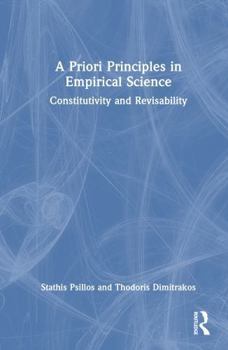
A Priori Principles in Empirical Science: Constitutivity and Revisability

In this book, Stathis Psillos and Thodoris Dimitrakos explore the question: how is empirical, and in particular scientific, knowledge possible? Most philosophers have accepted that some restrictions must be placed on empirical knowledge in order for it to be possible. Yet considerable debate has revolved around the precise nature of such restrictions, above all how knowledge can be said to be a priori.
The book traces the development of the concept of the a priori in the philosophy of science, beginning with the Descartes-Newton controversy. The discussion then turns to Leibniz and Hume, Kant's conception of synthetic a priori principles, and Mill's radical empiricism, which sought to eliminate the a priori altogether. The book also examines later transformations of the debate, including the emergence of non-Euclidean geometries and their challenge to the Kantian view, Poincar 's conventionalism, the development of the relativised a priori within logical positivism, and the Quine-Carnap debate over analyticity.
Building on these historical and philosophical discussions, the authors develop and defend a novel functional conception of the a priori - captured by the idea that "the a priori is as the a priori does" - according to which a priori principles are those that play a constitutive role in scientific theorising while remaining open to revision.
An engaging and wide-ranging philosophical investigation of the a priori, this book will be of great interest to students and researchers in philosophy of science, metaphysics, epistemology and the history of the philosophy of science.
Related Subjects
PhilosophyCustomer Reviews
ThriftBooks® and the ThriftBooks® logo are registered trademarks of Thrift Books Global, LLC
