


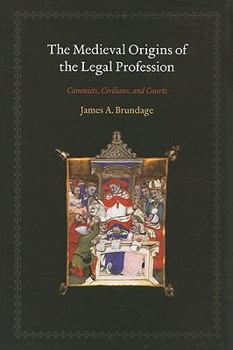
The Medieval Origins of the Legal Profession: Canonists, Civilians, and Courts
(Part of the Quantum Books Series)

Select Format
Select Condition 
Book Overview
In the aftermath of sixth-century barbarian invasions, the legal profession that had grown and flourished during the Roman Empire vanished. Nonetheless, professional lawyers suddenly reappeared in Western Europe seven hundred years later during the 1230s when church councils and public authorities began to impose a body of ethical obligations on those who practiced law. James Brundage's The Medieval Origins of the Legal Profession traces the history of legal practice from its genesis in ancient Rome to its rebirth in the early Middle Ages and eventual resurgence in the courts of the medieval church.
By the end of the eleventh century, Brundage argues, renewed interest in Roman law combined with the rise of canon law of the Western church to trigger a series of consolidations in the profession. New legal procedures emerged, and formal training for proctors and advocates became necessary in order to practice law in the reorganized church courts. Brundage demonstrates that many features that characterize legal advocacy today were already in place by 1250, as lawyers trained in Roman and canon law became professionals in every sense of the term. A sweeping examination of the centuries-long power struggle between local courts and the Christian church, secular rule and religious edict, The Medieval Origins of the Legal Profession will be a resource for the professional and the student alike.
By the end of the eleventh century, Brundage argues, renewed interest in Roman law combined with the rise of canon law of the Western church to trigger a series of consolidations in the profession. New legal procedures emerged, and formal training for proctors and advocates became necessary in order to practice law in the reorganized church courts. Brundage demonstrates that many features that characterize legal advocacy today were already in place by 1250, as lawyers trained in Roman and canon law became professionals in every sense of the term. A sweeping examination of the centuries-long power struggle between local courts and the Christian church, secular rule and religious edict, The Medieval Origins of the Legal Profession will be a resource for the professional and the student alike.
Format:Paperback
Language:English
ISBN:0226134342
ISBN13:9780226077604
Release Date:September 2006
Publisher:University of Chicago Press
Length:176 Pages
Weight:1.80 lbs.
Dimensions:1.5" x 5.9" x 8.9"
Customer Reviews
1 rating
Splendid Work of Modern Political Theory
Published by Thriftbooks.com User , 16 years ago
What is democracy? What SHOULD democracy be? How can we maximize what we think of as important precepts for a democratic society? Such questions are the subject of Robert Dahl's seminal work, "A Preface to Democratic Theory." (1956) Dahl begins by taking Madisonian democracy to task. Forged largely in the mind of James Madison, this model of democracy was embodied by the early United States, emphasizing constitutional checks on majority rule (the so-called "tyranny of the majority) and an "extension of the sphere" to include more factions -- competing interest groups -- into the political system, so that a majority would be less likely to form. By today's standards, this system was profoundly undemocratic, with political sovereignty and equality obscured by a bizarre obsession with preventing majority rule. Dahl argues that this can largely be explained by historical context: Many of the Founding Fathers, including Madison, were propertied slave owners and thus had a vested interest in preventing a mostly property-less population from acquiring the reigns of power. If Madisonian democracy is found to be lacking, what about a majoritarian system? As simple as the concept seems at first glance, Dahl lucidly demonstrates problems that would arise with such a model: What would happen if two policy options received the same amount of votes? What about the intensity of either side? Should a largely ambivalent majority reign supreme over an extremely passionate minority? Also, is political equality necessarily the axiom a political system should epitomize? After a brief discussion of the intensity problem, Dahl advances his most significant contribution to political science: the notion of "polyarchy." The modern United States is a polyarchy, or a system with relatively democratic processes for controlling leaders. It is important to note, however, that polyarchy does not equate to democracy. It merely meets necessary but not sufficient conditions for democracy. Finally, this Expanded Edition features a brief update by the author of how his arguments have held up over time (50 years later). Dahl is confident in the continued relevance of his work, but has adopted a more tempered view of Madison. Reflecting on letters and writings produced by Madison after the nation's founding, Dahl finds that Madison developed a more democratic view of majorities once he experienced the country's continuing evolution. Madison was still a slaveholder, however, even if an enlightened one. Only gradually did the country move away from his original vision of society. Dahl's blend of empirical work, theory, and the fact that he addresses normative concerns (something that is rare in political science these days) make this a must-read for curious citizens and scholars alike. Recommended Reading: --Federalist No. 10 (will help you follow along with Dahl's arguments) --Polyarchy: Participation and Opposition (The polyarchy concept developed more fully) --Democracy and
Copyright © 2026 Thriftbooks.com
Terms of Use | Privacy Policy | Do Not Sell/Share My Personal Information | Cookie Notice | Cookie Preferences | Accessibility Statement
ThriftBooks ® and the ThriftBooks ® logo are registered trademarks of Thrift Books Global, LLC
ThriftBooks ® and the ThriftBooks ® logo are registered trademarks of Thrift Books Global, LLC
