


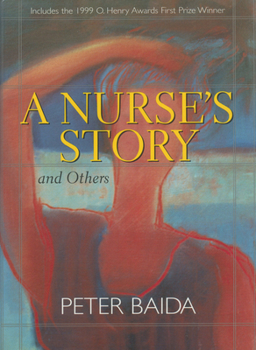
A Nurse's Story and Others

The lead story in this posthumous book, a revelation of a dying nurse's memories, was the first-prize winner in the 1999 O. Henry Awards. Tragically, within months of receiving this recognition, Peter Baida died at the age of forty-nine. "What a gifted storyteller we lost when Peter Baida died so young!" said John Barth. "Tough love and unsentimental compassion for the old, infirm, and fallen run through these wise and moving stories. In several of the best of them, one feels a whole novel's worth of life." The stories intertwine to form an emotional arc which carries the reader from despair to joy and back again. Baida is unhesitating in his close-up exploration of current social dilemmas. Recurrent in these stories are issues of ethical obligation to those living on the margins of society, the ethics and politics of unions and unionization, the contrasting values of various social classes, and the genuine significance of plain-old ordinary life. Baida presents both sides of the equation in his stories as supposed social solutions pose additional problems for his characters. He writes serious stories about the inherent duplicity of outcome following even the most well-informed life decisions. In "No Place to Hide" when confronted by the son of his mother's black housekeeper, a divorced, middle-aged, Jewish man in New York faces the uncertainty of his own life and the complexities of race and friendship. In "Mr. Moth and Mr. Davenport" as old issues of mob violence and union control resurface among the new realities of old age and loss, an unexpected love affair blossoms for retired residents of a Detroit apartment building. In "A Doctor's Story" a young man faces his family's past and his own moral confusion during discussions with his dying grandfather, a former Nazi doctor. "A wry, radiant compassion suffuses these remarkable, moving, deceptively simple stories," Johanna Kaplan says in praising this book. "With an encompassing intelligence and economy that take your breath away, Peter Baida gives us 'ordinary' characters--nurses, patients, parents, grandparents, old unionists, old friends--whose urgent memories and imperfect passions reveal and celebrate the subtle heroism of everyday life."
Format:Hardcover
Language:English
ISBN:1578063183
ISBN13:9781578063185
Release Date:April 2001
Publisher:University Press of Mississippi
Length:248 Pages
Weight:0.80 lbs.
Dimensions:1.0" x 5.3" x 7.2"
Customer Reviews
2 ratings
Modern Morality Tales
Published by Thriftbooks.com User , 20 years ago
Summary: A collection of stories about moral and ethical dilemmas and the impact of individual choices on society. This volume of nine passionately written stories is, if nothing else, a lesson in perseverance. Author Peter Baida submitted his title story to 22 publications. All rejected it. A more easily discouraged writer might have given up after, say, the 10th rejection, but Baida continued submitting his story. Eventually, editor No. 23, Peter Stitt of The Gettysburg Review, accepted and published "A Nurse's Story." You can probably guess the rest. "A Nurse's Story" won first prize in the 1999 O. Henry Awards. It was a vindication for the author and an indictment of the 22 editors who apparently saw no merit in the story. However, this book is more important for its contents then for its history. Peter Baida's voice is distinctive. His short stories boast a solid moral center, a concern with day-to-day ethics and responsibilities. Baida appears to be an unsentimental Christian whose outlook is similar to that of the Catholic Worker movement. He is clearly for the "little guy" and against the dehumanizing effects of both corporations and unions. He reveals a social consciousness that harkens back to the proletarian literature of the 1930s, but leavened with the irony and ambiguity of the 1990s. Baida also reveals a streak of mysticism and other-worldliness - in stories such as "A Nurse's Story" and "The Rodent," the dead come back to converse with the living - qualities that perhaps turned off editors more inclined to realism and minimalism. But Baida's writing isn't screechy and preachy. He writes smoothly and subtly, with humor and some experimentation. "Points of Light," a story of how one's politics change with age, is written almost entirely as dialogue. Many of Baida's stories don't follow the classic unity of time; instead, they experiment with chronology, skipping back and forth through the decades, covering a lifetime or several lifetimes in a few pages. Baida can show us "the big picture" while still focusing on the details. Not unlike the short stories of Alice Munro, Baida's short stories feature enough character and plot to sustain a novel. In stories such as "Class Warfare" and "Mr. Moth and Mr. Davenport," Baida comes across as pro-union, but with a jaundiced eye. He doesn't ignore the sincere concerns of management, nor does he ignore the corruption and violence of the unions. "Class Warfare" is a pitiless account of a newspaper strike, narrated by one of the strikers, and tells of deals made with the devil by both sides in the conflict. Baida knows that all actions - and inactions - have consequences, some of which reverberate through society and across generations. This is what Robert Penn Warren once called "the spider web theory of history": No matter what spot of the web is touched, the entire web vibrates. Baida also knows that individuals sometimes must make agonizing choices in li
COMPASSIONATE, COMPELLING HUMAN PORTRAITS
Published by Thriftbooks.com User , 24 years ago
The stories in this volume are incredibly well-written and moving -- Peter Baida was obviously a talented, caring writer. I was unfamiliar with him or with his work until I chanced upon this book on the 'recent fiction' shelf at the library -- I'm really glad I picked it up.The stories here deal with people we might consider to be ordinary until we read about them. The love of his characters gives Baida the power to flesh them out fully, to make them whole -- to make us care about them. Mostly told as reflections on their pasts, they depict turning points -- times at which we are given a choice to make in our lives or in our actions. The characters don't always make the best choices -- as in real life, hindsight is much clearer that our 'real time' options -- but Baida passes no judgements upon them. He presents the facts of their lives and allows us to draw our own conclusions. Even those characters whose choices are poor -- even reprehensible -- are not without their redeeming qualities, rather like the human beings who populate this globe.Baida's narrative powers are immense -- and his characters live and breathe on the pages before us. The title story in this collection was the first-prize recipient of the 1999 O. Henry Award -- and well-deserved. It's a shame that Baida died shortly after receiving this honor. We can only imagine what literary gifts he would have given us since then -- but this volume is a fine testament to his wonderful talent.
Copyright © 2026 Thriftbooks.com Terms of Use
| Privacy Policy | Do Not
Sell/Share My Personal Information | Cookie Policy | Cookie Preferences | Accessibility Statement
ThriftBooks® and the ThriftBooks® logo are registered trademarks of Thrift Books Global, LLC
ThriftBooks® and the ThriftBooks® logo are registered trademarks of Thrift Books Global, LLC
