


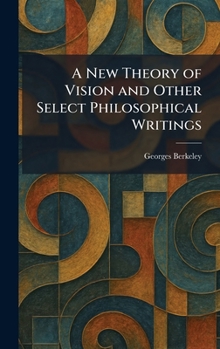
A New Theory of Vision and Other Select Philosophical Writings

"A New Theory of Vision and Other Select Philosophical Writings" offers a profound exploration into the nature of human perception and the foundations of reality through the works of George Berkeley, one of the most influential figures in British empiricism. In the primary treatise, Berkeley challenges contemporary assumptions about how we see the world, arguing that our perception of distance, size, and situation is not an innate mathematical calculation but a learned association of visual and tactile ideas. This work remains a landmark in the history of psychology and optics, bridging the gap between physical science and the philosophy of the mind.
The collection further showcases Berkeley's development of subjective idealism, or immaterialism, where he posits that material substance does not exist independently of the mind. Through clear and rigorous argumentation, these writings examine the relationship between the observer and the observed, the role of God in the sensory world, and the limits of human knowledge. Berkeley's elegant prose and provocative conclusions continue to stimulate debate in metaphysics and epistemology. This volume is an essential resource for students and scholars seeking to understand the evolution of Enlightenment thought and the philosophical roots of modern cognitive science.
This work has been selected by scholars as being culturally important, and is part of the knowledge base of civilization as we know it. This work was reproduced from the original artifact, and remains as true to the original work as possible. Therefore, you may see the original copyright references, library stamps (as most of these works have been housed in our most important libraries around the world), and other notations in the work.
This work is in the public domain in the United States of America, and possibly other nations. Within the United States, you may freely copy and distribute this work, as no entity (individual or corporate) has a copyright on the body of the work.
As a reproduction of a historical artifact, this work may contain missing or blurred pages, poor pictures, errant marks, etc. Scholars believe, and we concur, that this work is important enough to be preserved, reproduced, and made generally available to the public. We appreciate your support of the preservation process, and thank you for being an important part of keeping this knowledge alive and relevant.
Customer Reviews
ThriftBooks ® and the ThriftBooks ® logo are registered trademarks of Thrift Books Global, LLC
