


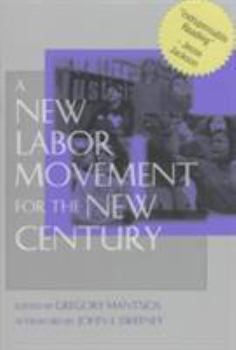
A New Labor Movement for the New Century


Select Format
Select Condition 
Book Overview
"This spirited collection is indispensable reading for anyone who wants to know what it will take for unions to inspire and mobilize a mass movement that will transform our nation, deepen our commitment to justice and democracy, and promote the inclusiveness that is key both to the labor movement and sustained economic growth."
--Rev. Jesse L. Jackson, Sr., President, Rainbow/PUSH Coalition
Format:Paperback
Language:English
ISBN:0853459371
ISBN13:9780853459378
Release Date:June 1998
Publisher:Monthly Review Press
Length:356 Pages
Weight:1.15 lbs.
Dimensions:0.8" x 6.1" x 9.0"
Customer Reviews
1 rating
Strong on idealism, limited realistic assessments
Published by Thriftbooks.com User , 24 years ago
The labor movement in the U.S. in 1994 was reeling from at least two decades of shrinking membership and loss of political and economic influence. The election debacle in the Fall of 1994 was the final blow that forced an acknowledgement that their leadership and manner of operation were hopelessly ineffectual. The new "New Voice" leadership of the AFL-CIO, elected in 1995, hit the ground running with ambitious aims for a labor turnaround. In a decided change from past practice, John Sweeney, the new president of the AFL-CIO, called for open debate and a critique of the labor movement from both within and without the labor movement. This volume contains the input of 27 individuals who participated in a labor symposium in anticipation of the transition. If not officials in labor unions, almost all of the contributors work within the labor movement in some capacity. These contributors all see the traditional union approach of firm-centered collective bargaining conducted by union officials and staffers as a guaranteed prescription for further union decline. But what do they think the labor movement should be doing or become? Their emphasis is on organizing both for workplaces and within communities, on the inclusion and expansion of opportunities for ethnic and gender minorities both in terms of membership and leadership positions in unions, on the impact of globalization and its main strategic initiative neoliberalism on working people throughout the world, on the need for renewed and independent political action, and on counterpoising worker democracy and solidarity against what amounts to the class warfare of capitalism. There is a great deal of idealism and optimism but unfortunately not a lot of realism and pragmatism that permeates this collection. Of course, that is somewhat understandable in that the New Voice leadership has given the labor movement renewed hope of a turnaround. Perhaps the vaguest notion put forward in these essays is the notion that unions, or the labor movement, need to become some sort of society-wide institution concerned with issues of the working class in general regardless of union membership. This concept is termed social movement or community unionism. One tactic proposed is for the labor movement, itself a rather vague concept, to form coalitions with social and political groups. Except in a few inner-city areas there is hardly any overlap between specific workforces and geographic communities. Despite the fact that some union-community coalitions have been successful, there is no discussion of the feasibility or the mechanics of unions becoming broad social institutions in most communities. There is general recognition from most of the authors that political power is essential to advance the position of working people. Disassociation from the Democratic Party and independent political action is urged. But what is lacking is any real assessment of the political orientation of the working class. One author comment
Copyright © 2026 Thriftbooks.com
Terms of Use | Privacy Policy | Do Not Sell/Share My Personal Information | Cookie Notice | Cookie Preferences | Accessibility Statement
ThriftBooks ® and the ThriftBooks ® logo are registered trademarks of Thrift Books Global, LLC
ThriftBooks ® and the ThriftBooks ® logo are registered trademarks of Thrift Books Global, LLC
